I’m not sure I’ll ever really be able to wrap my head around how this one relatively smallish soul-sac I occupy can so quickly convey itself around time and space, Jetsons-like, and in hours be in such widely different places, geographic or psychological. I know I sound like a cavewoman, being amazed by air travel and complex modern lives, but yeah, I’ll own it. Just the physics of it all astounds me. It’s surprising in the macro sense – the globetrotting possibilities within a day, a week. But even in the normal day, as I pinball in my virtual world of work, the relationships in my heart, the thousands of miles I log mom-ubering my kids – I feel like an M.S. Escher painting. And honestly, I’m usually too focused on the next thing I have to do, the next work or child need, or most likely – some internal rumination – to even really know where I actually am. Maybe this adds to my cavewoman surprise when I look up and notice I’m in a new place.
But there are times when it’s easier to awaken to where I am. Certain events facilitate this – vacations and crises both come to mind as occasions that push us into fully occupying a space by way of relinquishing control, forcing us to be open to what it might mean to be fully present to the place we are standing in, and what it means to us – to me – to Be there at a particular moment in my own timeline.
I remember so well a conversation from my days working at ExxonMobil – and its culture that moved people around globally every two years not unlike foreign service – except no one could go very long without doing time in Texas. I was resistant to this and my friend and manager at the time said – “Relax, it’s only place.” That struck me as so odd, because I remember thinking – “But place is everything!” That some might feel different, as of course many do, and that anything could be more important, was anathema to me. Maybe it’s being from land as identifiable and fertile as Louisiana, but place – the very idea of place – matters deeply to me and has driven so many of my decisions, overwhelmingly for the better. I live where I do now simply because I like this place.
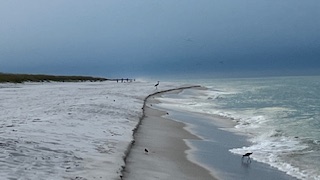
In July I traveled from Hiroshima, Japan to Pensacola, Florida. There were a couple of stops in between, but these two poles stood as axis within the same week. I can’t imagine more culturally or physically disparate locations – not to mention the whiplash in moving between them – but in fact, what they shared so strongly in common was an insistence to be noticed, to be witnessed, demanding that I occupy their spaces with my full presence.
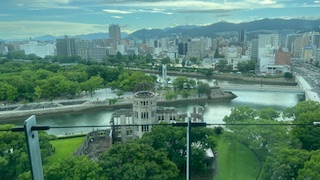
Hiroshima was a tremendous surprise as a place I didn’t expect to find so inspiring and optimistic. I knew there would be the history, and the history would be painful and hard, but I didn’t anticipate what the city would do with that history – asking its international visitors to step inside it and then join in positively imagining a future without nuclear bombs, through education and advocacy – but also through art and play and virtual experiences. Unlike so many other places I’ve been to where past trauma was memorialized in a largely static way – Dachau, Auschwitz, post colonial Africa, the 9-11 Memorial, plantations in the South – Hiroshima manages to openly present its past AND actively imagine a new future. Within the space of two hours, my son and I walked, astounded and silent, first through the Hiroshima Peace Memorial Museum, then Peace Park, the Children’s Garden, and finally the incredible Orizuru Tower for Global Peace – a stunning high rise building with a view over the mountains and winding river, as well as over, of course, the Atomic Dome – Hiroshima’s ground zero which still stands as a haunting skeletal reminder. At Orizuru, we folded paper cranes in memory of Sadako Sasaki and dropped them down the 14 story glass silo with the hundreds of thousands of others in our own wish for peace. To leave the building you had to either take a 7-story spiral slide all the way down (for real) or walk the descending spiral filled with dozens of murals promoting global understanding all the way down.
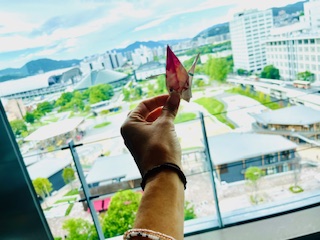
But before the slide, we stood on the rooftop balcony, surveying the view and talking to the winsome young docent Kevin-from-Pittsburgh who had come 8 years before when his college roommate suggested it, and decided to never leave. “I think I could do that too,” said Henry, turning to look again at how the rivers and mountains spooned each other 270 degrees around the town. “You know, come to study abroad maybe and never leave.” Who would have thought – Hiroshima, a name synonymous with devastation, could be in fact so magnetizing that I might have to travel here regularly to see my eldest. A place that is healing itself by actively trying to spread healing and peace with the world.
Five days later we stumbled, bleary eyed and jet lagged out of an Uber and onto to the sugar white sands of Portofino beach on Pensacola Island, just in time to hear a boy in a “Shark Bait” T-shirt holler, “Mama, I just saw a Big Ass Fish!” We’d made it just in time to reunite with the rest of our family – and spend a week between working (me), recovering from jetlag (both Henry and I) and, all of us, toggling between walking the shore and escaping to a shady spot in the pool when it got too hot. During the whole week, I kept thinking of Anne Morrow Lindbergh’s book, Gift from the Sea. One summer in the early 1950’s, Lindbergh (yes, that Lindbergh – an aviator in her own right) left her husband and five kids in New York and headed for the beach in search of communion with her own soul. She wrote with beautiful fluidity about how necessary it is to be receptive and passive in the face of an ocean that commands your attention and it reminded me of what a friend had once said when I most needed it, “just get close to the water and let it work on you.” Lindbergh wrote:
“The beach is not the place to work; to read, write or think… Too warm, too damp, too soft for any real mental discipline or sharp flights of spirit… The books remain unread, the pencils break their points and the pads rest smooth and unblemished as the cloudless sky. No reading, no writing, no thoughts even—at least, not at first.
At first, the tired body takes over completely… One is forced against one’s mind, against all tidy resolutions, back into the primeval rhythms of the seashore. Rollers on the beach, wind in the pines, the slow flapping of herons across sand dunes, drown out the hectic rhythms of city and suburb, time tables and schedules. One falls under their spell, relaxes, stretches out prone. One becomes, in fact, like the element on which one lies, flattened by the sea; bare, open, empty as the beach, erased by today’s tides of all yesterday’s scribblings.
But it must not be sought for or — heaven forbid! — dug for. No, no dredging of the sea bottom here. That would defeat one’s purpose. The sea does not reward those who are too anxious, too greedy, or too impatient. To dig for treasures shows not only impatience and greed, but lack of faith. Patience, patience, patience, is what the sea teaches. Patience and faith. One should lie empty, open, choiceless as a beach — waiting for a gift from the sea.”
It’s not lost on me that Anne Morrow Lindbergh was writing during her solo primitive beach retreat in efforts to mark a pivot in her life as she shifted into the second half – one not marked with aging decline, but rather as she puts it, a “period of second flowering” when one is “free for growth of mind, heart and talent.” I am very much occupying that internal place these days.
What did Hiroshima and Pensacola Beach have in common for me? Both commanded I occupy their spaces, that I awaken to where I was standing and turn my face towards it. In Hiroshima, towards the past with the long and hopeful telescope into a more peaceful future. To witness the older man with a sign around his neck, “In utero survivor, free talks” with his head thrown back in laughter in front of two tourists. To witness the Red Bird Monument in Peace Park, across from the Atomic Dome, dedicated to Miekichi Suzuki, a novelist who lived and wrote in the late 1800s and early 1900s. In 1918, he launched a children’s literature magazine that promoted and shared the first songs and fairy tales for children in Japan. He went on to teach teachers how to educate their students on writing composition and free verse to truly develop their creativity by participating in it. Twenty-seven years later nearly every school child between ages 8 and 15 died in the August 6th atomic bomb – a staggering nearly 90% of all the city’s school-aged kids were out that morning working on a citywide student-led demolition project. The Atomic bomb museum in Hiroshima shared the horror of them streaming into the river, hoping it save them from the burning firestorm. But the Red Bird Monument at the river’s edge focuses more on the healing than the devastation, quoting Suzuki, Japan’s Father of Children’s Literature, “I will forever dream, simply as I did in my boyhood, and therefore will suffer only a little.”
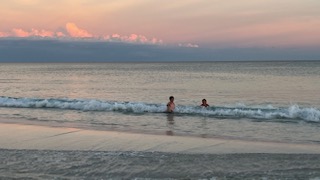
In Pensacola, a place where the body meets the sea and requires a full exfoliation of all the to-do’s, all the obligations, its waves a pummeling training ground for awareness, I kept turning my face to the insistence of the ocean. Not too long ago, I told an older friend I could only hear waves as loss, leaving the beach again and again. “That’s just where you are in your life,” she said.” Keep standing there, keep listening to them.” When Lindbergh was watching the ocean’s waves roll in and out, alone from her family’s demands in the early 1950’s, she was writing about the same fear of change, fear of loss, fear of non-constancy experienced through the changing nature of relationships. Maria Popova, one of our most well-read modern philosophers says this about what Lindbergh’s book might mean for us now, “The fear of change dissolves when we come to see love not as a vector of constancy but as a rosary of nows, its core promise not that of permanence but of presence.”
This time, at the beach, moving through the days I was there, where the minimal work was getting done and all my kids were healthy and happy and my eyes kept drifting, over and over, to the ocean – I thought, I will look back on this time and remember, I was content. Sure, there times of discontent in the future, and then I will be content again, but right now, I am content. Now. Now. Now. A rosary of nows.
In Hiroshima, the take-away was even more straightforward. Here is an example, on a city-scale, of what it looks like to live beyond your past and to be far, far larger than your pain.
 ebeauvaisblog