Leverage

“Well, ma’am, you know what Archimedes always said?” asked Justin via phone, a man I’d met 30 minutes prior through Facebook Marketplace in my efforts to sell a long-unused 6-foot heavy wood and metal martial arts training equipment filled with sand called a Wooden Man. 

While working out the transaction details, Justin told me at length about his struggles with work, recovery, holding down a job, getting an ADHD diagnosis and meds to help – all part of why buying this equipment felt so important to him to help him get back on track in his life.  The logistics of this sale were tricky – requiring me to perfectly time a pit stop 3 hours into a 6-hour road trip to pick up my kids from a spring break adventure they were on. And if Justin were to flake on me, as so many do on Facebook Marketplace, there would be no room in the car for my kids’ suitcases and beach gear on the drive back and the Wooden Man would have to be abandoned between a Cracker Barrel and an Exxon in Charlotte, NC. 

“No ma’am, I’ve got the cash. I’ve set my alarm set and I set a second alarm my ex-girlfriend gave me. I will be there,” Justin reassured me.  If he wasn’t the good person he turned out to be, he might have simply lied in wait behind that Cracker Barrel until he saw a harried, angry middle aged lady wrestle a large sand filled leviathan out of the back of her Telluride and heave it bitterly towards the dumpster.

But he wasn’t. Justin was a good egg, responding good naturedly when I called back to say I’d hit a snag – I didn’t have the upper body strength to hoist it into the back of my car.

“Well, ma’am, you know what Archimedes always said?”

I love it when my own latent snobbism is called to the mat, giving me another shot at scrubbing it.  I didn’t expect this young man, who already had lived through such challenges by his early 20’s, to tell me about Archimedes. 

“No, I don’t. What did he say?”

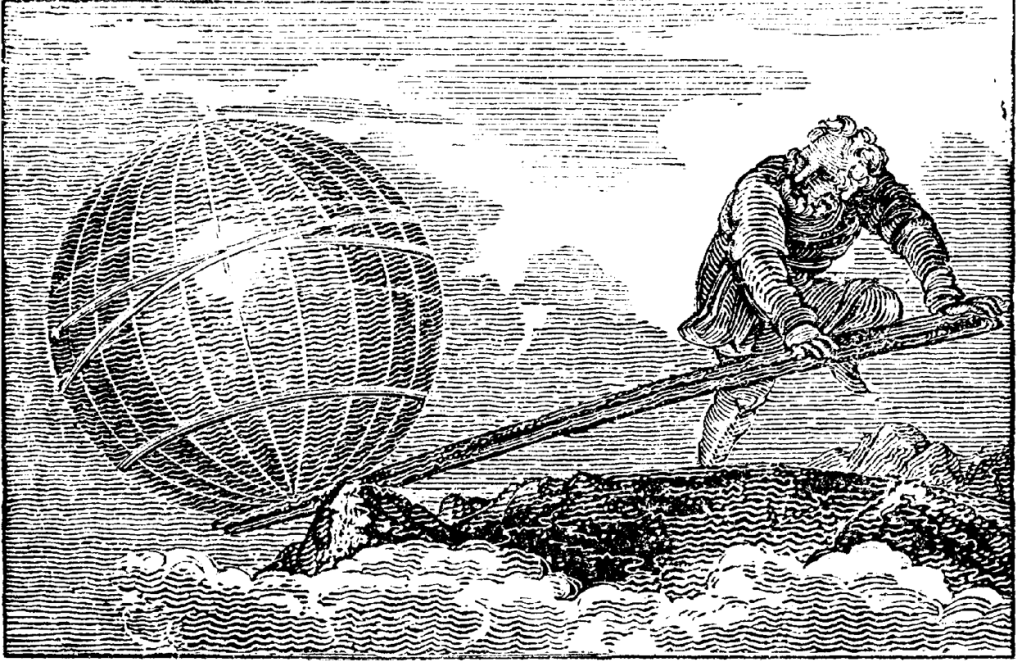
Justin went on pleasantly. “Archimedes said, ‘Give me a lever and fulcrum and I can move the world.’ And ma’am, you can almost always find something to use as a lever.  Just look around your garage – plywood, cardboard.” He paused and drew a big dramatic breath, “You’d be AMAZED by what you can do with cardboard!!!”  

I could tell there was a real excitement and energy there about cardboard – probably a couple of great stories about feats of impossible human strength pulled off by broken down Amazon boxes, but I felt the need to hurry off the phone with this new information and inspired advice and give it a go.

“It worked! Go, Archimedes!” I texted 10 minutes later and he shot me back a thumbs up and what appeared to be a Parthenon emoji with the reply, “Fuck yeah!!”  I told a friend about it all laughingly at dinner that night and she told me it’s only a good story once I made it back safely and insisted I drop a pin of the meetup Exxon. But Justin made good on the rendezvous the next day and now, months later, it’s nice to imagine him whaling on that Wooden Dummy after work as a security guard in Raleigh, saving up for his own place and dreaming about big shit he can move with some extra heavy cardboard and an ingeniously-placed fulcrum. 

While I was sliding that cardboard between the car and the Wooden Man back in March, I think there was a flattened refrigerator box being slid between me and my world.  

Like a lever on a really stable and big fulcrum, it was a subtle lift and shift – one that I wouldn’t feel for months, not until the dizzying excitement that I’d left the ground and was gently being put down in a slightly new place.  Transitions are like that.  I had looked up Archimedes quote and thought it interesting – debates about translations aside – that a fuller version read: “Give me a lever long enough and a fulcrum on which to place it, and I shall move the world.”

I’ve become expert at cramming tiny spades and butter knives into nooks to try to move what’s heavy or stuck and needs adjusting in my world. It’s sometimes successful, sometimes not.  But oh, the long lever! That’s where the real movement happens and requires so much positioning, aligning, and fully addressing the weight of the thing to be moved. 

Just before the spring break road trip – Facebook marketplace adventure, a dear friend came to visit and I sat on the couch with her and described the subterranean reservoir of lonely I was feeling.  It was as though I was standing at the shore of its dark, deep waters – all I had lived and lost and thought would be my future contained inside, and it was so vast and so dark I couldn’t see the banks of the other side, any other possible reality.  How do you move a lake?

With a lever long enough. 

I think the first positioning of that lever must have been in being willing to talk about the Big Sad of that feeling – with safe friends over the past couple of years. You have to take an honest and accurate measure of the heft and size of what you want moved. And then once it’s in place, and you’ve opened your heart to possibility, to movement, and leaned all your body weight into it, it’s patience.  God, I resent and hate this so much. Will I ever learn to be patient? (Will I? When? When? When????).  In the movement of big things with long levers, nothing  happens for the longest and it all looks like stagnancy and failure and flies buzzing and sore shoulders for the effort.  

Then a shift.  The kind where you can tell, you’ve got the underbelly of the thing – not grazing a slippery side – but the very seat of it. 

My lake isn’t moved, but it’s moving. I’m not naïve enough to think that it will never not be a reservoir — the edges of its banks rising and falling with my heart – but what’s changing is its placement and its tributaries in and out. It’s moving from the stagnancy of a crater lake  to one fed by rivers and streams. The long lever has shifted the pain and loneliness to something that also contains possibility and hope. 

Timing, patience, willingness to lean one’s shoulder into a herculean effort – these are necessary for lake-moving, but so is paying attention and meaning making. To move something, we have to imagine its shape-shifting possibility as well as our own possibility to be willing and hopeful and vulnerable enough to make a fervent little wish.  This isn’t possible when we are in the tunnel vision of pain. In Something in the Woods Loves You Jarod Anderson writes about how meaning-making is a creative collaboration between us and our relationships with others or nature that has true generative power to leverage our lives.  The act of seeing meaning in a great heron spreading its impossibly long wings over the water in flight is a creative collaboration between the heron showing up and our own imagination to connect this witnessing to our life’s burdens and hopes. 

Anderson says if we don’t think a heron is magic, we need to broaden our definition of that word, as he breaks down the avenues to get there: 


“There are two paths to magic: Imagination and paying attention. Imagination is the fiction we love, the truths built of falsehoods, glowing dust on the water’s surface. Paying attention is about intentional noticing, participating in making meaning to lend new weight to our world. An acorn. The geometry of a beehive. The complexity of whale song. The perfect slowness of a heron. 

Real magic requires your intention, your choice to harmonize. Of course it does. The heron cannot cast starlight onto the dark shallows to entrance the bluegills. Not unless you do your part. You must choose to meet her halfway. And when you do, you may find that magic isn’t a dismissal of what is real. It’s a synthesis of it, the nectar of fact becoming the honey of meaning.”

I think for me, and maybe this is true for you too, that honey of meaning is required fuel to keep going when something is being moved by a long lever.  It’s sustaining and gives hope and tiny encouragements. It’s why I write. It’s why I walk the trails behind my house up to the highest spot and look at the mountains.  Those old blue brontosaurus-backed mountains are showing up for me, and I’m seeing in them the meaning I need to keep going, keep imagining, while the long lever does its slow lake-moving work.

“Go Archimedes!”

“Fuck yeah!”
Counting Crows

“Ah, there’s the sorrow,” said the boy Liam as we passed the car wreck with the ambulance and two cop cars by the side of the road, “I knew there was one coming today, but didn’t know where it was.”

Liam, newly 8 years old, is the boy we picked up every morning for a week last summer to carpool to my youngest son’s nature camp out in the country. I did mornings, his folks did evenings, saving each other a precious hour each day and a lot of mileage, and gaining some pretty good conversation. 

“The sorrow?” I asked. Such an old, lonesome word for this chipper, snaggle toothed boy with his fidget spinners and slime and camp backpack.  And did he really say “Ah” at the start with just a whiff of a wistful old Irish lilt?

“Yes,” he said solemnly, “a sorrow.”  

“But how did you know you would see a sorrow?” 

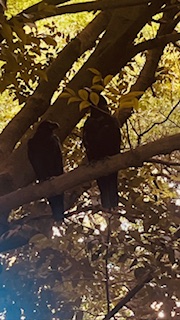
“Because I saw two crows this morning. So, you know, I knew there would be a sorrow today. I thought the sorrow was when my dogs ran out the front door this morning and I cried and didn’t think we’d get them back. But that wasn’t it.”

He paused meaningfully.   “It was the wreck.”

I like this accounting of sorrows. Two crows = One sorrow. No more. Exacting, precise, reassuring both in its historical recounting (it wasn’t the dogs, they came back and that was all fine) and in its future predicting (no more sorrows to worry about today!)  Liam leaned a little further back in his booster seat and confidently pulled out his newest fidget spinner and began speculating on whether they’d make forts or fires that day.

As I took on the snakey curves of the country road that would eventually empty us by the clear Moorman river at the bottom of the Blue Ridge, I thought about how, too, this notion of crows heralding a sorrow that needed to be watched for, and ultimately, found and acknowledged might be another, less spoken of way to cultivate awareness in our lives.  

Life can be such a whirlwind of trying to control a yo-yo while riding a roller coaster – equal parts nauseating and thrilling  – that we spend a lot of time and energy trying to get quiet and still in efforts to stay in connection to ourselves and stop the room from spinning. At least I do. And in that stillness, there’s some well-meaning pressure to notice what’s good and lovely and loving in our lives.  Awareness is, after all, an antidote to the spin that dissociates us from each other and our own selves.  

But awareness might also be dispassionately but attentively acknowledging the sorrow. I feel in myself a resistance to this even as I type it. Several months ago, I was noticing this hollow feeling that comes to me as I drift off sleep and first wake up – a deep and lonesome missing of my own self. Missing my awareness to my life.  My dear friend and mentor Paula said simply, “it is so hard to wake up to our own lives.” And she’s right. I find it’s also not easy to remember that waking up requires not trying to put myself to sleep – in all the ways I numb myself with lullabies of work, wine, the internet.  My own children and their constant and complicated choreography of lessons and activities and plans, which seems essential, has a benedryll effect, submerging my consciousness just below the next pick up, the next meal prep. Even my seemingly self-reflective ruminations – a circular lullaby, just the chorus on repeat, spinning gauze around me.

In my better moments, I think of awareness as something to capture with effort and hustle, like a firefly. I try to catch hold of its tail as it’s flying past me in the blue gloaming light. I listen to my children’s breathing in the pre-dawn morning and ignore the call to get a little more work done on my laptop before they wake, in efforts to make up for the fact I will have to take away from work to drive them places later in the day. I work hard to spool the thread up against myself and sit on the couch with the dog to meditate, then journal.  Soon, though, I’m lost again to the laptop and the dishwasher. It’s no bad thing, this practice of trying to architect still moments to inhabit for a few minutes, before falling back in the maelstrom and doing it all over again.   And yet – I also think this jumps over something more gentle and more essential – the solemn naming of what we are experiencing – before chasing the enlightened calm.

I never lose this notion (and myself along with it) more than when my kids are experiencing pain.  My daughter has been battling – and defeating – her own demons like an Amazon.   But she, like anyone battling an enemy within, especially at the tender age of 16, grows tired and doubtful and weakens. The afternoons are particularly hard for her as her mood dips precipitously and everything “feels like shit.” I feel my own heart plummet like a lead weight to my shoes and any plans I had hoped to make fizzle as my mood dims alongside hers.  I didn’t acknowledge the sorrow – I became it, along with her.  I unzipped its ratty grey zipper and climbed inside, and worse – became resentful as we both ran out of oxygen in that sad sack that I couldn’t fix for her.   And while she’s far stronger now than summer before last – learning to just turn towards her pain, her sorrow, and acknowledge without action remains a lifelong effort.

Paula recently told me I am not turning towards my own grief, my own hollow, and giving it the attention it needs. I want Presence-to-Myself to be the rosy kind –  long quiet walks in some beautiful tick-free forest, a meditative labyrinth in a churchyard, a poem scratched out in my journal.  When so often Presence-to-Myself, to my life, is face down on the carpet or behind my own cupped hands – no expansive vista, no act of creation – just the act of turning towards something too big and lonely to name. “It’s okay,” she said, “to simply say, ‘This is hard. What I am living and feeling is hard.’”  

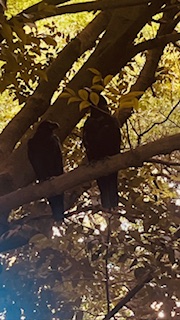
And even now, as there is a levening, a blessed lightening in my life – the accounting is the same. I have to remember to stay honest first with what I’m actually feeling before finding the silver lining. Two crows, it turns out – that is, if you go by the old rhyme* anyway, is joy.  ( I didn’t tell Liam that) But you’d only know that after counting and really seeing that first old bird. 

This is getting better at awakening, this is non-enmeshment, this is self-kindness and a lightening of the heart, from – hand to heart, a tiny man in a booster seat with a fidget spinner.  Awareness is joy, yes – but not without counting the crows.

Ah, there’s the sorrow. 

* Counting Crows Nursery Rhyme:

One for sorrow,
Two for joy,
Three for a girl,
Four for a boy,
Five for silver,
Six for gold,
Seven for a secret never to be told.

Eight for a wish,
Nine for a kiss,
Ten a surprise you should be careful not to miss,
Eleven for health,
Twelve for wealth,
Thirteen beware it’s the devil himself.

Place Matters: Hiroshima to Pensacola

I’m not sure I’ll ever really be able to wrap my head around how this one relatively smallish soul-sac I occupy can so quickly convey itself around time and space, Jetsons-like, and in hours be in such widely different places, geographic or psychological.  I know I sound like a cavewoman, being amazed by air travel and complex modern lives, but yeah, I’ll own it.  Just the physics of it all astounds me.  It’s surprising in the macro sense – the globetrotting possibilities within a day, a week. But even in the normal day, as I pinball in my virtual world of work, the relationships in my heart, the thousands of miles I log mom-ubering my kids – I feel like an M.S. Escher painting. And honestly, I’m usually too focused on the next thing I have to do, the next work or child need, or most likely – some internal rumination – to even really know where I actually am.  Maybe this adds to my cavewoman surprise when I look up and notice I’m in a new place. 

But there are times when it’s easier to awaken to where I am. Certain events facilitate this – vacations and crises both come to mind as occasions that push us into fully occupying a space by way of relinquishing control, forcing us to be open to what it might mean to be fully present to the place we are standing in, and what it means to us –  to me – to Be there at a particular moment in my own timeline. 

I remember so well a conversation from my days working at ExxonMobil – and its culture that moved people around globally every two years not unlike foreign service – except no one could go very long without doing time in Texas. I was resistant to this and my friend and manager at the time said – “Relax, it’s only place.” That struck me as so odd, because I remember thinking – “But place is everything!” That some might feel different, as of course many do, and that anything could be more important, was anathema to me. Maybe it’s being from land as identifiable and fertile as Louisiana, but place – the very idea of place – matters deeply to me and has driven so many of my decisions, overwhelmingly for the better. I live where I do now simply because I like this place.

In July I traveled from Hiroshima, Japan to Pensacola, Florida. There were a couple of stops in between, but these two poles stood as axis within the same week. I can’t imagine more culturally or physically disparate locations – not to mention the whiplash in moving between them – but in fact, what they shared so strongly in common was an insistence to be noticed, to be witnessed, demanding that I occupy their spaces with my full presence. 

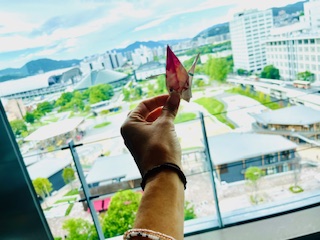
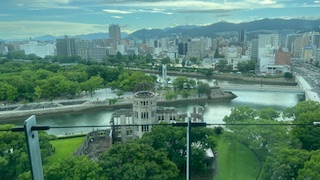
Hiroshima was a tremendous surprise as a place I didn’t expect to find so inspiring and optimistic.  I knew there would be the history, and the history would be painful and hard, but I didn’t anticipate what the city would do with that history – asking its international visitors to step inside it and then join in positively imagining a future without nuclear bombs, through education and advocacy – but also through art and play and virtual experiences. Unlike so many other places I’ve been to where past trauma was memorialized in a largely static way – Dachau, Auschwitz, post colonial Africa, the 9-11 Memorial, plantations in the South – Hiroshima manages to openly present its past AND actively imagine a new future. Within the space of two hours, my son and I walked, astounded and silent, first through the Hiroshima Peace Memorial Museum, then Peace Park, the Children’s Garden, and finally the incredible Orizuru Tower for Global Peace – a stunning high rise building with a view over the mountains and winding river, as well as over, of course, the Atomic Dome – Hiroshima’s  ground zero which still stands as a haunting skeletal reminder. At Orizuru, we folded paper cranes in memory of Sadako Sasaki and dropped them down the 14 story glass silo with the hundreds of thousands of others in our own wish for peace.  To leave the building you had to either take a 7-story spiral slide all the way down (for real) or walk the descending spiral filled with dozens of murals promoting global understanding all the way down. 

But before the slide, we stood on the rooftop balcony, surveying the view and talking to the winsome young docent Kevin-from-Pittsburgh who had come 8 years before when his college roommate suggested it, and decided to never leave.  “I think I could do that too,” said Henry, turning to look again at how the rivers and mountains spooned each other 270 degrees around the town. “You know, come to study abroad maybe and never leave.”  Who would have thought – Hiroshima, a name synonymous with devastation, could be in fact so magnetizing that I might have to travel here regularly to see my eldest. A place that is healing itself by actively trying to spread healing and peace with the world. 

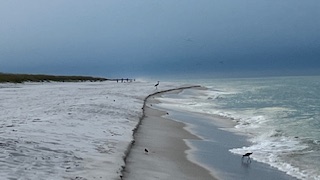
Five days later we stumbled, bleary eyed and jet lagged out of an Uber and onto to the sugar white sands of Portofino beach on Pensacola Island, just in time to hear a boy in a “Shark Bait” T-shirt holler, “Mama, I just saw a Big Ass Fish!”  We’d made it just in time to reunite with the rest of our family – and spend a week between working (me), recovering from jetlag (both Henry and I) and, all of us, toggling between walking the shore and escaping to a shady spot in the pool when it got too hot.  During the whole week, I kept thinking of Anne Morrow Lindbergh’s book, Gift from the Sea. One summer in the early 1950’s, Lindbergh (yes, that Lindbergh – an aviator in her own right) left her husband and five kids in New York and headed for the beach in search of communion with her own soul.   She wrote with beautiful fluidity about how necessary it is to be receptive and passive in the face of an ocean that commands your attention and it reminded me of what a friend had once said when I most needed it, “just get close to the water and let it work on you.”  Lindbergh wrote:

“The beach is not the place to work; to read, write or think… Too warm, too damp, too soft for any real mental discipline or sharp flights of spirit… The books remain unread, the pencils break their points and the pads rest smooth and unblemished as the cloudless sky. No reading, no writing, no thoughts even—at least, not at first.

At first, the tired body takes over completely… One is forced against one’s mind, against all tidy resolutions, back into the primeval rhythms of the seashore. Rollers on the beach, wind in the pines, the slow flapping of herons across sand dunes, drown out the hectic rhythms of city and suburb, time tables and schedules. One falls under their spell, relaxes, stretches out prone. One becomes, in fact, like the element on which one lies, flattened by the sea; bare, open, empty as the beach, erased by today’s tides of all yesterday’s scribblings.

But it must not be sought for or — heaven forbid! — dug for. No, no dredging of the sea bottom here. That would defeat one’s purpose. The sea does not reward those who are too anxious, too greedy, or too impatient. To dig for treasures shows not only impatience and greed, but lack of faith. Patience, patience, patience, is what the sea teaches. Patience and faith. One should lie empty, open, choiceless as a beach — waiting for a gift from the sea.”

It’s not lost on me that Anne Morrow Lindbergh was writing during her solo primitive beach retreat in efforts to mark a pivot in her life as she shifted into the second half – one not marked with aging decline, but rather as she puts it, a “period of second flowering” when one is “free for growth of mind, heart and talent.”  I am very much occupying that internal place these days. 

What did Hiroshima and Pensacola Beach have in common for me?  Both commanded I occupy their spaces, that I awaken to where I was standing and turn my face towards it. In Hiroshima, towards the past with the long and hopeful telescope into a more peaceful future.  To witness the older man with a sign around his neck, “In utero survivor, free talks” with his head thrown back in laughter in front of two tourists.   To witness the Red Bird Monument in Peace Park, across from the Atomic Dome, dedicated to Miekichi Suzuki, a novelist who lived and wrote in the late 1800s and early 1900s. In 1918, he launched a children’s literature magazine that promoted and shared the first songs and fairy tales for children in Japan. He went on to teach teachers how to educate their students on writing composition and free verse to truly develop their creativity by participating in it.  Twenty-seven years later nearly every school child between ages 8 and 15 died in the August 6th atomic bomb – a staggering nearly 90% of all the city’s school-aged kids were out that morning working on a citywide student-led demolition project.  The Atomic bomb museum in Hiroshima shared the horror of them streaming into the river, hoping it save them from the burning firestorm. But the Red Bird Monument at the river’s edge focuses more on the healing than the devastation, quoting Suzuki, Japan’s Father of Children’s Literature, “I will forever dream, simply as I did in my boyhood, and therefore will suffer only a little.”

In Pensacola, a place where the body meets the sea and requires a full exfoliation of all the to-do’s, all the obligations, its waves a pummeling training ground for awareness, I kept turning my face to the insistence of the ocean. Not too long ago, I told an older friend I could only hear waves as loss, leaving the beach again and again. “That’s just where you are in your life,” she said.” Keep standing there, keep listening to them.”  When Lindbergh was watching the ocean’s waves roll in and out, alone from her family’s demands in the early 1950’s,  she was writing about the same fear of change, fear of loss, fear of non-constancy experienced through the changing nature of relationships.  Maria Popova, one of our most well-read modern philosophers says this about what Lindbergh’s book might mean for us now, “The fear of change dissolves when we come to see love not as a vector of constancy but as a rosary of nows, its core promise not that of permanence but of presence.” 

This time, at the beach, moving through the days I was there, where the minimal work was getting done and all my kids were healthy and happy and my eyes kept drifting, over and over, to the ocean – I thought, I will look back on this time and remember, I was content.  Sure, there times of discontent in the future, and then I will be content again, but right now, I am content. Now. Now. Now. A rosary of nows.

In Hiroshima, the take-away was even more straightforward.  Here is an example, on a city-scale, of what it looks like to live beyond your past and to be far, far larger than your pain.

Leaptiles

“Leap Days are for leaping,” I wrote in 2016, when posting my inaugural blog, a personal challenge to write an essay a week (almost) for one solid year, starting on Feb 29, 2016 in efforts to determine two things: 1) whether I could develop the discipline for writing; and 2) whether anything I had to say might resonate. I had no idea how much it would give me, or how creatively expansive and fertile those 4 years would be. My kids were all still very small and so active then, and my life was segmented into 27,000 different pieces between chasing them, my consulting work, teaching yoga, staying involved with family, friends and community – and writing.  I picture my life then like a cotton candy machine, spinning at a speed that can’t even be seen while the spun candy threads magically appear like webbing within the chaos.  Maybe because of the chaos.

The four years following, from Leap Day 2020 – on the very eve of the world exploding and my world collapsing and then it all slowly coming back online – to today, might be described in opposite terms.  The cotton candy machine abruptly stopped and all of us gone to ground – first all the activities stripped away with COVID, then my identities too through the personal implosion. Fallout, solo walks, therapy, tears, loneliness, multiple moves, and ultimately a new spin started, with all the hope and sugar that a new momentum brings. 

It’s interesting to me that these Leap year periods (can we call them Leaptiles?) coincide so deftly with chapters in my life, and not just the past two Leaptiles, but I can go back 4 years and 4 years and 4 years and 4 years and could chapter title them all with what they meant to me, with very little blurriness or exception or resistance.  Maybe it’s my own weirdness that those four-year intervals seem to so neatly segment themselves in what otherwise feels like an oblong blur. It’s certainly not true for individual years –  I can feel almost violent with rebellion when New Year’s rolls around and with it the cultural expectation to reflect and forecast. But perhaps four years is just enough space …. Or maybe my astrologist friend Rachel has an answer.   

Do any of you feel the same way on Leap Day about your Leaptiles*? (*is it catching on yet?)

I’ve been thinking a lot lately about what the super-real theologian Kate Bowler has said and written about how we don’t really experience time in a linear or a progressive way. She talks about how we actually feel time in different ways and at different speeds that then color how we see ourselves and our place in the order of things. She describes the three major ways we experience time as Tragic Time (time slowed down and bubbled around you after Something Big has happened, and everything is in too bright, hyper-crystalline focus), Ordinary Time (the kids’ school lunches, the work emails, health care open enrollment, the oil change) and Apocalyptic Time (the experienced-in-community feeling of time we have around things like the pandemic or climate change or wars or justice). Bowler, who herself bounced among Times when she was diagnosed with Stage 4 colon cancer in her thirties, says that each of them are precious and insightful, but none of them are places where we can live forever without missing something.   By “something,” I think she means something essential about ourselves and the world we are currently occupying, what our energies are allowing us to open to, what we are being asked to respond to. Stay too long in Ordinary Time and we never awake to the fleeting beauty of an individual winter sunset. Stay too long in Tragic Time and we become too encased and brittle in our own glass to hear each other.

I’ve been chafing a little lately at the boundary of this Time I’m in, here at this new Leap Day. I move through the routines of what has now ebbed from Apocolyptic time to Tragic Time to Ordinary Time, with a good bit of ping ponging back and forth between the latter two, as is normal – and between the daily routines of work and children, I feel a little discomfited somewhere at the margins of bed-kitchen-car-desk-couch. On the Tragic Time side of the net, I’ve learned a lot in the past four years about how to remain as equanimous as possible with what is happening, about Acceptance and limits of my control, about living with Uncertainty.  And there’s a true peace from these learnings that creates space and hope for a renewed momentum.  One the Ordinary Time side of the net, I’ve gotten a lot of shit done.  I’ve weathered some massive storms (with a face to illustrate) and anchored myself and my children in new lives, while hanging on to all our beloved roots, and bouncing over new waves.  Most of the time, I’m worn-the-fuck-out from the effort, but I’m also proud too, because it’s given us the stability and fertile ground to start a new spin.  One that incorporates all of where we’ve been, but with many doors opening onto possible new opportunities.  The volley between these two Times, in particular, continues on the micro every day, as it does for us all, and so long as I can gather up the capacity to bring awareness to it, I can right-size my energy to where I am. This helps.

And yet.  At the dawn of this new Leaptile (I’ve now fully coined it, y’all) I think I’m feeling this bit of discomfit because I’m playing a tiny bit too much Woodoku late at night instead of paying attention to this faint call I’m starting to hear. I think I’m being asked to shift my energies and respond to something new in these next four years. Most likely, it’s something small, like to really figure out a good under eye moisturizer without consulting the internet and then being aggressively targeted by ads (personal recommendations most welcome!) But maybe it’s something a little less vapid, or not even new – like remembering more of who I am a level far more essential and foundational than the weather patterns of these past four years.  And I won’t know unless I listen and I open to it.  I’ve come to know this opening isn’t a one-time action, but a decision to make over and over, each morning. Or as often as I can remember to, with grace given for all the times I can’t. 

Some Leap Days are for leaping. Others for hunkering. Other still for listening and opening.  I hope whatever yours is asking of you for your next four years, you are receiving like a same-day Amazon Prime. 

My heart is reaching out to fervently wish a healthy, restorative and happy Leaptile for us all!

The Story

It’s a story I’ve told a thousand times. That’s how I figured it didn’t hold any trauma. I can tell it and retell it like a Ted talk on repeat; I know just where to put the adjectives. Except it wasn’t until this past week that I realized the story I told was in fact a story of trauma, the one that deepened it and fed it, even as it prided itself on describing the details and actions with precision.

Trauma – chronic trauma that is – is less about a precipitous event and more about framing.

Here’s the story I’ve always told about the hours and days following my mother’s death when I was 14:

The evening I learned my mother died – on today’s date, June 25th, in 1990, I was whisked to my grandmother’s house in a small town an hour away with my younger brother. My aunt was there, with her mental illness and a purse full of narcotics. My grandmother was there too, her normally steely hazel eyes broken and misplaced like a Picasso. Various uncles and cousins and great aunts were crammed into her small kitchen with the brown and orange plaid wallpaper and deep freezer in the corner with a jumble of aloe plants on top. The noise was deafening.

My great uncle RC waved us all quiet as he strained to hear on the mustard yellow rotary phone attached the wall above the aloes. He hung up the phone and announced that someone would need to get on a plane the next morning to start packing up the house and to get my and my brother’s personal things, in advance of he and another uncle driving up the U-Haul in four days time.  “Someone’s got to go up there right away,” he said.

There was a pause that lasted what felt like a full minute. I looked at my grandmother, her face almost unrecognizable with grief. My aunt, my mother’s sister, was still keening and rocking in her chair at the table.

“I’ll go,” I said.  “I can do it. It’s fine.”

All the noise started back up in the kitchen, Uncle RC picked back up the phone, plans were made, and I was on a plane the next morning. When I reached the airport in Wichita, Kansas, my mom’s best friend and business partner picked me up and took me to her home. The plan was I’d stay with her and together we would go to my house the next morning and begin packing in advance of all the family and U-Haul arriving later in the week. But when I set my suitcase down in her grown daughter’s bedroom and sat on the bed, she crumpled next to me and put her head in my lap and wailed, “I can’t do it. I can’t live without her. And I can’t go there tomorrow!”

The next morning, she dropped me off at my house alone, tearfully waving with her lit Vantage cigarette that she’d check on me and be back after work at 5 to pick me up, and was so sorry she couldn’t face it with me. 

I was fine all morning. I remember starting with my room, loading all my stuffed animals into giant garbage bags and then working on my bookshelves, crammed with Lives of the Saints books and the complete Babysitter Club series.  At noon, I got hungry and went into the kitchen.

It’s permanently seared in my memory the beige enamel pot I was holding in the center of the kitchen, filled with cooked macaroni noodles, at the exact moment I froze and the shock wore off like a robe slipping off me.  I dropped the pot in horror, the macaroni noodles spilled across the floor. My mother was dead. And there was no way I could be in that house alone, without her, for another second. 

I screamed and ran to my neighbor’s house, the front door swinging open behind me, and breathlessly asked to use her phone book to look up the only other adult I could think of who might be able to take care me: my most recent teacher.  Barbara Tuminello had taught me 8th grade the previous year and I adored her.  She was one of those teachers who manages to teach how to be a good human, what to value most, and how to laugh at yourself, somewhere in the middle of algebraic equations and the transitive property. She was the one who immediately came to mind when every other adult I tried to lean on during that time fell away.  And when she answered on the second ring, I breathlessly blurted out that I needed her to come pick me up RIGHT NOW PLEASE.

She was there in less than 20 minutes, took me get my suitcase from Pat’s, then brought me back to her house where I lived with her and her family for the next month, while I said goodbye to that chapter of my life along with much of my childhood.

I’ve told this story over and over as a story of hardship, a story of resilience, a story of strength, and a story of the bizarre power of automatic pilot during shock and grief.  But what I missed until very recently was that this is actually a story of Help.  Since I was a small child, I have told myself some version of “I am all alone and have to do everything myself.”  So in wearing those particular glasses, it was easy to see this story as another one, maybe even the seminal one, of me all alone and having to carry a too-big load myself.  And with me in the center of the story, that’s a pretty convincing narrative.

But what I missed until recently is that Barbara is the center of the story. She’s the one who leaps into action to help save a 14-year-old former student.  There is no telling what she had to do that day. Her kids were around 9 and 12 then, or maybe even younger, and as a teacher, she reserved her summers for family time and projects around the house.  As a mom of kids around that age now, I know what distraction and busy looks like, and I can’t say I would have taken the call, or at least would certainly not have been there that fast, nor opened my home up without question to a stricken teenager the way Barb did. 

The story, as it turns out, is not a story of my aloneness in a crisis, nor even my resiliency and strength. It’s a story of connection, of help, of how held and supported I am, even and maybe especially when I am brought to my knees.  The story has always been less about the person drowning, and more about the one who jumps in the water.

I am internalizing this new realization now, as I am again feeling so desperately alone, stumbling under a burden too big for my shoulders after my husband abruptly and mysteriously left me and our children, without discussion.   In the immediate days and weeks and months following his relapse and abandonment, I would bring my forehead to the wall, or a tree trunk, or the floor, and pray the only prayer I had, “Help.”  I prayed it over and over, “Help.Help.Help.” And minutes later, without fail, a friend would call or text to check on me, or my youngest would wrap his sticky arms around me and slide a note in my pocket, “Mama, I love you with my hole herat.” (sic)

What if I could change the lenses in my glasses to see the help that is always there, the abundance of the support and love always running its little stream along the margins, instead of what I have lost? How could I even revisit the old stories to see them more broadly – like my stepmother telling me she and my dad had no idea I traveled up to Wichita all alone at 14? How might I begin to expect life’s generosity for me, instead of its hurdles?

I am about to leap with my children into a new chapter, and maybe soon after a new city in order to give us a fresh start and new life. I am terrified, but I am picturing Barbara zipping into a driveway in her minivan. I am witnessing my stepmom and chosen family helping us get there and the friends of friends I have never met before in places saying, “Let us help you find a neighborhood and good schools” and dear friends now saying, “this is right.”  Our transition is one colored by support and abundant gifts.

Life is generous.  And there is always Help.  This is the new story I am telling. 

chronic (adj.)

early 15c., of diseases, “lasting a long time,” from Middle French chronique, from Latin chronicus, from Greek khronikos “of time, concerning time,” from khronos “time” (see chrono-). Vague disapproving sense (from 17c.) is from association with diseases and later addictions. Literal sense “pertaining to time” is rare in English. Also of being or embodying something habitually, regularly, “he is habitually a chronic grumbler.”

The negative medical association of chronic is well known and not especially interesting to me. But chronic as related to time, of something becoming habitual over a slingshot of our days and years, or even as ultimately becoming fused with our identity – that has my attention.  What in our lives has been “chronic”? And how has or how can this habituation — even if it occurs by way of the deep drain of a long-term illness — open a door onto a new and clearer view of the world?  A view that seems inevitably colored by gratitude.  This notion of chronic has interested me a great deal lately.

In my life, I have come to know and understand the tablecloth-pulling hat trick of unexpected disaster. I know by first name the bad news that comes with a phone call and leaves you sitting at the table all of a sudden without any linens, your wine glass and salad plate knocking hard against each other in reverberating shock.  But walking the long walk of a chronic autoimmune illness with one of my children has been an altogether different marathon experience.  For the past 20 months that we’ve been living in this place, including the most recent 7 months we had a name for it, I’ve been trying to wrap my head around what this feels like. That is, what it feels like to have a child with a chronic and progressive illness, who’s daily wobbling on this balance between having to leave his mainstreamed life of school, homework, friends, and also still participating in it, trying to making a go of it, despite the inflammation raging in his brain.  I look at my kitchen and see the story it tells – on the left side of the stove there are no fewer than two dozen pill bottles and supplements; on the right, a school reading log to sign, popcorn, leftover Halloween candy.  The simultaneity of sickness and normalcy, itself a bipolar burden to bear.

There is a strange push-pull in living this world without the ability – as you might be able to do for a sudden emergency – to expatriate out of the “normal” world.   When disaster strikes, we stop going to work or school for a spell, all our routines halt and our communities (hopefully) respond and step in.  In a long-term slog of a chronic illness, we manage the upheavals and sleepless nights behind our front doors with part of our brain on red alert, and still chit chat at the grocery and take the conference calls and sign up for fall carnival volunteer shifts.  It’s less of a double life back-and-forth toggle and more of the necessity to live two lives simultaneously. Planning playdates or extracurricular activities while emailing with doctors across the country with the subject line in ALL CAPS.  Playing a daily game of musical chairs that involves trying to get in as much work as possible before I get the biweekly call from the school to come early. Wondering whether I should put energy into home school, or even unschooling for a spell, or whether he is getting better and might actually like to learn guitar.

I’m constantly calibrating, re-calibrating.  Can he stay in school next semester? Can we all go to see the new art installation park downtown?  Would a family trip be too much? Am I over-medicalizing? My calculations are often totally wrong and we end up at the art installation park with our snowcones melting in our hands as Henry cries and screams and melts down 10 feet away.  Frequently, too, these experiences involve someone else, unsuspecting and well meaning, engaging me in a conversation like nothing’s wrong. “Yes, middle school is going fine. Sure is a big adjustment!”

But the push-pull of chronic illness, I’ve learned, is less about the rest of world and more about me.  It’s exhausting and discomfiting, like wearing a too-small mohair sweater in July. And in my typical coping strategy of sharing transparently – or TMI, depending on your comfort level with me – I will send out emails that say something to the effect of “WE ARE ALL WEARING INCREDIBLY FUCKING ITCHY SWEATERS WE CAN’T PULL OFF AND WE ARE NOT ALL RIGHT.”  Best beloveds will then jump to reach out, and I – instantly embarrassed by my drama, by the fact that we’re not undergoing chemo or recovering from a car accident, that it’s just another Wednesday night with this beast – will back pedal saying, “we’re okay. We’re okay. I’m sorry to worry you.”  Why does the emergency feel more warranting of help? I am reminded of Brene Brown’s talk about the deep shame we often feel when there is something bad happening in our lives. I am discomfited with my own self, see?

I will often feel lonely and want to be around people and as soon as I do and am in conversation, I want everyone to stop talking and let me just curl up on the couch again alone.  I dread someone asking me how Henry is because I hate this is all we are, but then I also find it’s the only thing I can talk about, and will bring it up at inopportune times, unsolicited and awkwardly, as in a meeting with a new client.  I can feel myself becoming one of those wide-eyed, wild-haired moms that chase grey-area diseases down every rabbit hole, but I can’t stop because what if the furthest rabbit hole is the one to heal Henry?  I feel as though I can see my friends only as though from a great distance, like through the wrong end of a telescope.  I am squinting across a great, dim expanse and trying earnestly to remember what is happening in their lives – a new job, trouble in preschool with a child, an upcoming trip. I know they’ve told me but I’m in molasses now and it’s all fuzzy. It feels like trying to remember enough French to order in a restaurant, and my tongue is thick without practice; I am straining at it, desperately wanting that old fluency back. Chronic illness, in short, is an uncomfortable simultaneous living in two worlds, neither of which feels sturdy and supportive.

But – and here’s the nut of it, y’all – what’s occurred to me recently is that none of these things is really the feeling I’m trying to capture and communicate. The long, tight squeeze of the “chronic” is just the passageway, the arc of time, like a tunnel that we are moving through.   What it brings us to, and who it makes of us habitually, is what matters.  It not like an acute crisis, the rock bottom disaster that breaks us open like a sparkly geode, painfully beautiful as that is.  The chronic is more the relentless rock-tumbler that seems to endlessly knock us around as it slowly – oh god, so slowly – makes our little average quartz selves into something else entirely. I don’t know that we can easily clock this transformation in a mirror. I think, very often, we can only know a new and deeper gratitude through our friends and beloveds — and our ability to appreciate and take joy in them.  We take so little for granted, all kindnesses fully felt felt and appreciated, after a buffeting like that.  I had the unexpected joy of seeing this through one of my children’s friends recently.

Last month, Steven and I slogged through the high-fructose insanity of what we call Hell Week: all three of our children’s birthdays within five days.  It’s intense, it’s joyous, it’s crazy-making and there are tears, ruined appetites, and a shocking amount of wastefulness in wrapping paper. But it also comprises some of our happiest and most helium memories – just all squished inside 120 hours.  This past year, we decided to harness the crazy by letting our twins each take a friend out of town to an LSU game on a generous grandparent offer. As a homage to turning twelve, the exit door of childhood looming, we let them each have their own hotel room with their respective friends and a lot of time to themselves.  They didn’t need our constant entertainment as much anymore, and anyway, there were photo filters and horror movies to discuss which we weren’t invited to.

For me, however, the fun of the weekend was overshadowed by the knowledge that we would have to leave by 8am Sunday morning to drive back quickly and get Henry admitted to the hospital for a two-day intensive immunotherapy infusion that we hoped would be a big part of his healing. The procedure was not without risk or side effects, like asceptic menigitis and skull splitting migraines, which could largely be avoided by pre-medicating with Ibuprofren and hydrating like it was a JOB.   Drinking a six pack of water bottles at a football game with cokes and Icees was a total buzzkill for Henry, but despite the partying, tailgating crowd around us, all I could see was a second trip to the ER because we hadn’t hydrated enough.

I turned to Henry’s friend Finnegan, and said, “Hey, in the spirit of being at a college football game and in support of Henry’s upcoming procedure, can you haze him to drink water all day?”  Finn looked up at me, still 11 years old, and blinked.  Behind him a couple of aging frat alums were smashing giant foam purple No.1 fingers into each other’s faces.   “I’m on it,” he said.

Finn set his watch to chime every fifteen minutes, whereuon he would look at Henry and chant, “Chug! Chug! Chug!” while Henry laughed, happy with his friend’s attention, and guzzled water.  After the game, we took the kids to a pizza place. Henry slumped into a foul mood as everyone ordered soft drinks he couldn’t have.  Finnegan stood up in the crowded restaurant, clanked his fork on his glass, and announced that he would be doing something to embarrass himself every time Henry finished a glass of water.

Henry instantly slugged back 8 ounces of water and Finnegan gamely stood up, clanked his glass again and loudly gave a toast to Henry in his best Monty Python accent.  “Give it up to me boy ‘Enry, who hath no haters!” After glass #2, he tried to order a mimosa at the bar, insisting that he had a rare aging disease that made him appear a cherubic faced sixth grader.  “It’s a burden and a curse, I tell you,” he deadpanned.  After glass #3, he stood and sang a solo from the Book of Mormon while we all clapped wildly and laughed until tears streamed down our cheeks.  Henry peed clear for a week after that dinner.

And of course, I’ve felt it so strongly in my own circle too.  Last week I held a yoga benefit workshop to raise money for medical professionals in Louisiana to receive free CMEs on Henry’s particular autoimmune disorder. I’d been worn down by a rough week with Henry’s symptoms and a quick but great trip with my stepmom and daughter just prior, and came skidding in on bald tires, emotionally, to teach.  But I came in way of the chronic, of the time tunnel that can lead to a new habitual way of viewing, so I saw people afresh, like a new lens in front of my eyes. I saw 15 yoga students who were friends and supporters, themselves carrying their own illnesses and body betrayals, their griefs and pain and stresses and round-the-clock on-call jobs, that each had individually shared with me. I saw them carrying those burdens and somehow, in the same hands, also carrying this gift of support to me and Henry and kids like him.

I saw a half dozen of my friends gather to meet me around a dinner table later that night.  I saw them wave dismissively, but lovingly when I did my usual awkward two-step and insisted were okay, no need to call out the troops, and then proceeded to cry a little bit onto my artichoke flatbread.  They loved me as they always do, inexplicably, but it wasn’t their love and support that moved me the most. It was through this heightened sensitivity where I could see their active love combined with each of their own pain and burdens, their hopes and struggles, that moved me so deeply.  I had a window into each of them showing up on their Sunday night, the contents their own arms held so fully visible, while still extending to me so much kindness. Somehow in living in two worlds through chronic illness, I felt I could see on two levels, the interior and the exterior, and my heart – that little oyster shell that had been rubbing its rough grain of sand, grew so soft and so big.

“Joy,” I heard the Reverend Betsy Eaves say today in quoting Nathan Eddy, “is a discipline, not an emotion. Joy is a discipline of perception.”  We have to choose, and the choice is not usually a coin toss. It almost always feels radically risky and high stakes.  Gratitude is the same.

To be chronic is to be in it for the long haul, to take it all in and view and feel all that’s around us on multiple planes, but with one heart.   How do we hold the love we are given? We hold it with the same hands we hold the pain.

I am coming through the chronic, I am barreling through the rock-tumbling time tunnel, and I am emerging more chronically grateful this Thanksgiving than I have ever been.

Earthquakes happen when weaknesses cannot be expressed


That much has been written about stress during the holidays doesn’t necessarily mean that we’re supersaturated on the subject.  I think it just means there’s a near-desperate hunger for discussion. Or maybe more than real dialogue, we need venting or the hysterical catharsis of laughter borne of tension, illustrated by Matt Damon’s recent SNL skit “Best Christmas Ever.”  Either way, I know I need to keep talking about it, because de-stressing during this time is a perennial lesson I can’t seem learn, much like “don’t leave a wet swimsuit on the bed.”  Specifically: Remember to make a LOT of extra space for myself during Christmas week.

For me, as much as I am aware of the potential T-bone collision created by my own overly helpful caretaking tendencies and my diametrically-opposed need to give myself downtime to write, meditate, walk and sit still with my grief during the holidays, I still run headlong, skidding over ice, helplessly towards it.  I think maybe we are all at risk of sliding and skittering, in one way or another, towards a 10-car emotional pileup this time of year.  We load up the rituals and gatherings into a stack of expectations that’s both heavy and glittering. But because so much of those expectations are rooted in the Christmases of our youth — and because time, inevitably, takes people away and mutates families — then there is a disconnect, a rigidity that expresses itself in many different ways.

Just over Christmas Eve and Christmas Day alone, I shouted “HURRY!!!” at my husband no less than 7 times, downed far too many glasses of champagne, and had several tiny, pinched and furtive cries in a couple of different bathrooms.  I’m not proud of any of that, but I realized, a bit too late, I should have given those tiny cries a bit more respect and space. That was my real Self talking to me – remembering Christmases past and missing my mom and dad, and feeling something deeply and authentically.  For as many holidays and birthdays I celebrate in the calendar year, none light up all the sensory and emotional buttons for me like Christmastime.   I’ve spun the calendar wheel around again and sing the same song, though the verses have changed. And so, of course this would bring up a wistfulness, a pause of sadness, even. But only because I’ve been loved and am loved, because I’ve had such joyous, happy Christmases in my past, even as I am making them for my children in my present.   It’s a shadow sewn into the light, a part of it, but I ignore it every year (“I don’t have time for that;” “I don’t want to be sad at Christmas”), and in so doing, I set myself up to act out all my worst coping skills. I chose to become brittle instead of softening.

Recently, I heard a talk that stressed the importance of celebrating All Souls Day, regardless of creed or faith, on November 1st – the day after Halloween that quietly kicks off the holiday season.  The speaker said it was so important to make space for our dead on that day so that we could attend to those losses with real care, well ahead of the bustle and cookie-making parties. She said that we might find a way, maybe a candle or special place in the house, to honor those we loved dearly. And for those with whom the relationship was difficult, we could honor the best of their and our own intentions and make a space to mourn what the relationship might have been. A holiday, in short, to feel grief – in all its multi-colored fullness – all that someone gone made you feel, all the love you shared, alongside the full weight and density of its vacuum.  Whew. There’s no shelf space for this on the seasonal aisle of drugstores – no wonder we don’t do much of it. But imagine if we did!

In reality, my reality, I ignore the opportunity to give myself that kind of holiday, and instead coming flying across November 90-miles-an-hour, careening two-thirds of the way across December until I slam into my own personal pile-up, teetering on the edge of canyon between expectations and reality.

The swinging rope bridge across these two great cliffs is, of course, self-compassion. Really radical, intentional, bad-ass self-compassion, that is.  Compassion, done well, is so active – and self-compassion so especially powerful. To be Compassionate AF, we must go about finding the work that can be done.  And usually it’s work we can barely recognize for ourselves, like my own task (which I rejected at the time) of staying in one of those bathrooms and have a nice, chest-lightening cry.

Xavier LePinchon, one of the world’s leading geologists who founded the field of plate tectonics, shared on Krista Tippett’s On Being podcast what fragility in geology has taught him about fragility in the heart of humanity.  Le Pinchon spoke beautifully about the earth’s necessary capacity to accommodate fragility and weakness.

“A capacity to accommodate fragility is a fundament of vital, evolving systems, whether geological or human … Earthquakes happen when weaknesses cannot be expressed. And communities which are rigid, which don’t take into account the weak points in the community, or of people who are in difficulty, tend be communities that do not evolve.”

What is weak – and vulnerable — must be valued so that it isn’t expressed cataclysmically. And I believe what is true in the macro is especially capital T true in the micro, in our own selves. We explode or freeze when we don’t express our vulnerabilities.  We transform the landscape and create new space when we do.   This is so hard for me to remember that sometimes I have to shake up my routine and shift my perspective to get there.

A couple of months ago, I went to a small retreat with 11 people I didn’t know.  When I wasn’t walking the trails by the river or napping or journaling, I was sitting in a circle with these strangers, who weren’t strangers for long, and sharing what lay both heavy and light on my heart, while listening to the same – all on the one condition that we didn’t say what we did for a living.   In this space, we were evolving by embracing and expressing what was most vulnerable. And it only happened because we created the space to shift our consciousness outside of ourselves … and then to look back from that place, tenderly, at our own selves.

One day our luminary retreat leader offered us a writing exercise.  “Picture yourself standing on a beach, watching a great and beautiful whale just offshore,” she said.  “Now shift your perspective.  Now, you are the whale in the ocean, looking at this person standing on a beach who is staring out into the ocean. What do say to her?”

If we could see our small, endearing, annoying little selves as a 90-foot Baleen whale might, would that not then widen and deepen the capacity to love ourselves, and to gather the strength to listen to our needs, even when it feels like sadness at an inconvenient and otherwise happy time ?  I know that what people wrestle with during the holiday season can so often be terribly complicated and untouchably private, but I do believe it could only help.

For what it’s worth, here is what my whale said to me:

“It’s All Right.

I am 163 years old and you are 42 years old and we span the distance of 121 years and several species bloodlines and that is still nothing to the sand you are standing on, and It’s All Right.

My seas are warming and acidifying and there are distances in some of your most defining relationships and a confusion in how you want to lead the 2nd half of your life, and It’s All Right.

My numbers are dying out and I often swim hundreds of miles alone and you carry forever in you the sorrow of a child who’s lost her mother and It’s All Right.

There are times I fill my great lungs and burst out of the water, spinning the frontier of my white belly to the sun, joyful in unexpected flight. And you, in your kitchen, when no one is watching, bump close the utensil drawer with one hip and break into a little dance, arms overhead, briefly and blissfully free free free.  And It’s All Right.

Because beneath the all rightness, we are both held, you and I, in the current of a deeper love. And I see you. You belong to me. I belong to you.

So breathe, tiny female human.  It’s okay.  It’s All Right.”

Treed


The treehouse in the backyard was in sad shape.  Wood greened and fuzzed and slick from the jungle moss that covers everything in Louisiana. The bright yellow slide scratched and out of date. An old tic tac toe game painted on the roof awning, years and years old.  My daughter Charlotte had the idea of remodeling it for her little brother’s 5th birthday.   The trouble was, it was either too damned hot or too rainy all summer to really tackle a big paint and refurb job like that.  But then the week before August’s birthday, things got real.

“We’ve got to go to Lowe’s right now and get paint,” Charlotte said, standing by the front door. “We’ve got to get busy!”

I had spent the weekend before in a cabin in West Virginia with dear friends, talking through the many things that lay both heavy and light on our plates. I brought up the fact that all of my sudden, my daughter, mere weeks shy of turning 11, looks 14.  At least.  She’s an early bloomer who’s been blooming for the past year, but in the past few months, her body has begun to really change, and to anyone else, she looks like a teenager. By anyone else, of course, I mean leering boys and men.  What’s more – she is striving to be older, to look older, to act older.

I’ve been so careful not to give her the impression that the world is full of bad people.  I want her to know it’s mostly good people – I don’t want her to be driven by fear, because I know fear closes hearts and breeds hatred and bigotry.  AND  – not but, but and –  I also know the stats. I know how many girls between 11-16 are sexually assaulted and how this window of time also coincides with a girl’s eroding self-esteem, particularly in terms of how she feels about herself physically or in intellectual esteem associated with “male fields”, like math and science.  Because they get attention, good or bad, for their looks, many girls quickly learn, if they haven’t already, that that’s where they are valued most by society, at their same time they are getting the message their voices and brains are devalued.  This never ends well.  Few of us make it through without sexual assault or an eating disorder or worse.

And then,  it’s not as though you’ve crossed the finish line – the pain of assault or abuse is housed within the body and mind, and is often crippling.  My husband is a clinical psychologist in a pain clinic and tells me that well over 75% of the women he sees for chronic pain have been raped or assaulted as children or teens.  This isn’t just a stat from his office – it’s a well recorded correlation across the mental health industry.  The pain simply doesn’t go nowhere.

I had avoided talking about any of this with Charlotte because I do want her to view the world as intrinsically good and also because I have been afraid that talking about sexual predation would take away some of her innocence and childhood.  But when we got the paint from Lowe’s and started painting the inside of the treehouse, I knew we had an opportunity. It was laborious and humid, the paint runny down the mossy planks as soon as we laid it on.   She was teasing me by stealing the paint off my paintbrush with hers every time I pulled it out of the can.  I dug in.

“So, you know when you wore your play make up and exercise outfit out of the house last week and I got upset? I need to tell you more about why.”

We painted and talked. I asked her what she knew about sexual assault, (she knew it was most often people that might know her, and not strangers. She knew to be careful about flattery), and it also gave her a place to ask me things (no, you didn’t get twins by “doing it” twice in one night, although that’s a totally fair question, and absolutely a woman gets to choose when she has a baby).  We got into the territory of unwanted attention and what was within her control about that. We covered the planks with our Jimmy Buffet turquoise while we talked, the sweat springing up instantly on our foreheads, and we agreed that it was unfair that women had to think about how they dressed to avoid catcalls or attacks.  I stole a glance at her.   I could see how my daughter is now, just as oblivious to herself as when she was 8, yet as leggy and curvy as a young woman and wanting to wear what she feels pretty in, as she should.  And yet. I am afraid for her.  How much do I tell her to keep her safe without projecting too much of my own fears, or too much of the world, onto her?

“It’s not fair,” she said again, before heading inside to cool off.  I felt sick. Like I had been preparing her for a future witness stand, ready to pre-empt the “what were you wearing question?” or its multitude of permutations.

When she left, I moved on to the 2nd coat. I am reliving many of my own assault moments – incidents that I didn’t think to report because it wasn’t technically rape and I never thought I had a voice, that anyone cared, that it mattered. The boy in college who did such a similar thing that Christine Blasey Ford has accused of Judge Brett Kavanaugh when he threw me down on a bed, pinned me there and ground himself against me until I was able to escape and get back to my friends. Nothing happened, right? Except for the fear that was lodged in me, except it changed how I entered a room for ever after.  I know from the National Sexual Violence Resource Center that one out of four girls is sexually abused before her 18th birthday, and it’s widely and credibly assumed that this number is too low because so few cases are reported.  I desperately want my daughter to be one that makes it to 18 — I want it for all our daughters.

All week long, when I got breaks between my work and the rain, I worked on painting the outside of the treehouse. There are so many wooden slats and planks, and everything is so wet, the task feels Sisyphean.  It’s also become clear that we will need to get some kind of AstroTurf for the floor of the treehouse to make it more inviting to sit and hang out there.  I spend a lot of time, mid-week, out there, hearing the occasional news update and revisiting both my own past and my conversation with Charlotte. Most of the time, rare time for me with my hands busy but brain free, I am questioning – how is making light or dismissing teenage assault as “horseplay” not just harmful to young girls who feel they have no agency or voice and ultimately come to blame themselves, but also to young men, because it unfairly stereotypes them all as toxic, misogynistic, and violent – and essentially give them a free pass to engage in these horrific acts?  How is just talking to my daughter her choice of clothing so complicated and maddeningly fraught?

By Thursday, all that remained was that godawful yellow slide and a rusty swing.  Charlotte had the great idea of spray painting it metallic silver, space-age style.  She ran off to school, and me – for the gazillionth time to Lowe’s.  I started spray painting while listening to Dr. Ford’s testimony about her sexual assault to the Senate Committee.   As I listen, along with most of America, with my heart in throat, my phone is blowing up.  So many friends, men and women, with so much sadness that this is where our country is right now.  A woman with an accusation of sexual assault shaking while being interrogated by a prosecutor, live before millions, and her accuser, a would be Supreme Court justice, tantruming between rage and tears.  What do we do with this?  We can do nothing and yet its outcome will affect our lives.  None of it in the proper setting, the just setting, the setting we would want for ourselves, our daughters, our sons if godforbid this happened to us. And it has, or it will, or we love someone has already walked this out.  All of my friends have a similar story, as I’m sure do yours – some no doubt are worse than others, like my friend who told me recently she still, decades later, lives in fear — actual fear for her safety and life — that the man who raped her decades before might come find her because she threatened to “destroy his reputation” by coming forward and reporting it and taking him to court (he was never convicted).

Have any of you seen Hannah Gadsby’s brilliant Nanette on Netflix?  Please treat yourself for 60 minutes if you haven’t – particularly relevant is her take on Picasso and the complicit, communal effort to protect powerful mens’ reputations. It’s made me think about my own destructive place in that fold. “We think reputation is more important than anything,” she says in this clip from the show, “Including humanity.”

Silver spray paint drips and runs. It’s very hard to get it smooth, like a mirror. And silver glitter paint, I found the hard way creates a roughness that makes speedy sliding hard.  Ultimately, what one needs is silver metallic appliance paint and a paintbrush to smooth it out.  It’s absurdly painstaking but at least by Thursday the weather had cooled, so it was easier going, and I finally could look forward to putting down the AstroTurf.  At Lowe’s, this kid employee asked the one cutting my ‘turf, “Who buys this stuff anyway? What do people even do with it?”  “Boats,” said my Lowe’s guy.  “And this lady,” he added, with a friendly cock of his thumb back towards me. “I’m not sure what she’s doing.”

I don’t really know what I am doing either.   This project might be a total time waster, or it might make a little boy happy. But the process feels like something, like a room I’m occupying this week.  It’s felt good to do these normal life things when I had just given my daughter a message that our national government was overtly contradicting.  You aren’t listened to if you report sexual assault. If you do so it will be at great peril and risk to yourself and all you hold dear.  The world will tell you your value is in how you look, but if you draw too much attention – or just randomly draw the short straw – this will be your undoing, the reason you are on opiates with back pain and seeing a pain psychologist in 25 years.  I reject this as Charlotte’s world. (I reject this as anyone’s world).

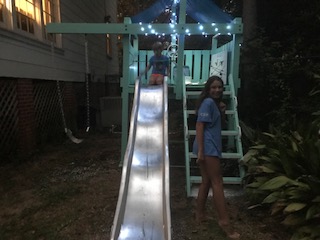
I want my daughter’s world to be as open-ended and magical as this play house we are creating.  Tonight we are hanging the lights and unveiling it for the birthday boy. Hopefully, our little half-baked project will breathe a little more life, a little more play, into this old treehouse.  And I am, actually, hopeful.


Love First

A friend of mine says this – Love First – by way of gentle advice.  What I think she means is that when your heart gets backed into a corner, and you are going over and over your well-reasoned arguments and grievances in your hamster wheel of a head, and still everything feels at an impasse: Love First.

She actually never said it to me, and I’m not sure she’s even said it more than once – but it came to me through another friend who had been helped by it. And such is the power of Love First, that when I heard it, it lodged itself within me, tapping out the shape of a window, a place that might be pushed open.

Which has been a good thing in my world, because it doesn’t take much lately for me to develop short, sharp teeth or feel like my heart has been shoved down into the toes of my shoes.  This is largely because the backdrop of the world has felt especially hard.  Rather, what’s been devastating has been how many people have reacted (or worse, not reacted) to the dumpster fire backdrop of the world, the nation.  It has felt like people don’t care about other people, even and especially the vulnerable, and this has crushed me.  I felt something break in me when the reports came in that children were being separated from their asylum-seeking parents at the border (and still are) and people then actually said, “well, you just can’t trust the news.”  Back when I wrote, “If the protests have you irritated or confused” in the days after the election, I honestly thought that it might help if I put a face on some of the people who felt reasonably afraid (African-Americans, LGBTQ, recent immigrants, ACA-holders, disabled) because candidate Trump had said demeaning and threatening things about them. I didn’t think people’s stories, stories about real people who I love, would change anyone’s political or even ideological belief system – I just thought they might care. That their own beating human hearts might soften towards the human hearts of others in pain with empathy.  … How naïve.

And like a bad boomerang, my disappointment and disillusionment in what has very much appeared like heartlessness from who I would expect to be good people has had the unfortunate effect of hardening my shell.  Writer and thinker Maria Popova says, “the most toxic byproduct of helpless resignation is cynicism — that terrible habit of mind and orientation of spirit in which, out of hopelessness for our own situation, we grow embittered about how things are and about what’s possible in the world… In its passivity and resignation,” Popova says, “cynicism is a hardening, a calcification of the soul.”

I’d been searching for something to soften this calcification when I remembered my friend’s reminder: Love First.

To me, Love First does NOT mean telling the racists down the block to come over for a game of Scrabble. It doesn’t mean accepting or agreeing to what I deeply feel harms another.  What it means to me is that I have to stay plugged in to the undercurrent of love that flows through us, and around us, all. I have to stay focused on that – first and foremost – for my own good.

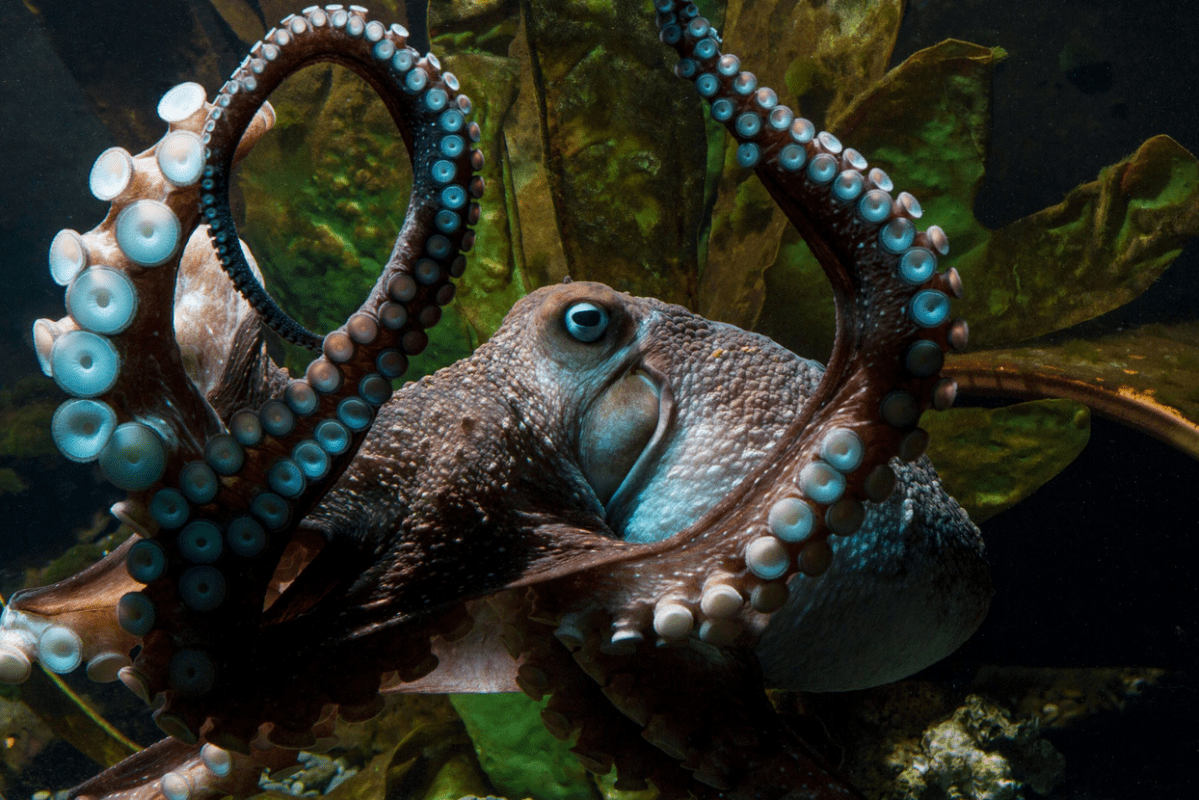
Love First is finding a way out when it seems impossible — when everything is enormous, including your own pain and sense of injustice, and the only opening is the size of a quarter.  We forget, I think, what the heart can do. We forget that the heart is like that amazing giant octopus, Inky, who made an incredible break for freedom a couple of years back by squeezing himself out of a small hole in his enclosure at the National Aquarium of New Zealand, slooshing across the floor, and escaping through a drain pipe no bigger than 4-inches to make it back out to open waters. (It’s worth mentioning that a less independence-minded octopus, Blotchy, remained behind).

It’s like Inky, the heart – without bones, without limits, able to shift and squeeze, finding its way out to a bigger ocean.

Often, for me, I can only do this a great distance – and I don’t think there’s anything wrong with that. In fact, I think it’s probably right and wise to protect ourselves in this way, when needed. We can love greater, in many cases, at a bit of a distance, rather than pressed up against each other’s grills and windshields. I have an aunt who’s seriously mentally ill, and her illness has tragically distorted her reality so much so that it is not just toxic, but dangerous to be around her, or even in communication.  So in my little tiny flawed efforts to try out this Love First business last week, the most I could do was light a virtual gratitude candle for my aunt and wish her well, silently from the across the country.  But in this small action, a giant anvil lifted.

With another relationship, I’ve been trying to Love First by stopping the rehearsing of arguments in my head, playing out endless scenarios – and replacing it with a memory of a great laugh we shared not too long ago.  And if I’m too frustrated or angry to do that, I go father back – to when this friend helped me when I was moving out to LA with my then boyfriend, now husband, and had little support or resources and she pressed an envelope of cash into my hands and told me I was always a great investment. I can usually get to Love First in this way.

I think Love First might mean often having to go back farther and farther and farther, however far it takes, until we can see some common denominator. Same species, if nothing else.  This might be less about a reconciling (which might never happen) than a dropping down to a bigger love of some subterranean river that we are all a part of – and saying, “Okay, I belong to that.”

No one has to know, there are no fireworks or Facebook posts or even phone calls.  But we know. It’s so subtle, and so profound. Love First.

Don’t get me wrong, I’m new at this and abysmal at it for the most part. Most of the time I feel like Blotchy, stubbornly stuck in the tank and thinking – “DAMMIT that looks scary and hard.  And why doesn’t anyone ever help me? Or see how hard I work? Or appreciate my interesting spots? When the hell is it feeding time already?”  (Oh Blotchy, I SO get you).

If cynicism is a hardening, a calcification – then Love First is a stretching of the ligaments.   For me, it’s a rejection of my flat-present day snapshot that people don’t care, and a reaching of my tentacles towards something greater, something better and more loving and inclusive. It’s the aperture of what I see reflected in the open faces of my children.

It’s Inky, busting out through the filter vent and bonelessly contorting through the pencil-sized drain so that he could be a part of the ocean again, so that he might be a part of the bigness and connectedness of himself.

My aunt doesn’t know – and won’t ever know –  I lit a candle for her. Sadly, we will probably never speak again. My friend doesn’t know I have to meditate on her previous generosity before reaching out to her.  Another loved one doesn’t know how much I focus on the river of love that flows between us, when I invite her over, whether or not she accepts (and she usually doesn’t). And who knows how many people need to do this with me? None of that actually matters, because my heart has squeezed through one of those cool bookcase secret passageways. It’s escaped and lightened, when I can manage this.

In this way, I don’t think Love First is an action, it is actually an internal migration. A shift in the way we think of our immobile, set firmament and introduction of a little fluidity.  It’s an inside job, is what I’m saying.

It’s our soul — at last and through the smallest of openings — finding the ocean again.

Evacuating Addiction-land

It is perhaps the most painful thing to realize that we are all, actually, separate people.  Which means that I am just as separate from the ones I love the Most as I am from the cashier at Target or Sarah Sanders or Oprah. And with that notion of separateness comes the awful secondary realization that I cannot fix anyone but myself. I reject this, formally and for the record, even while I know it to be true.  It’s pretty much opposite to how I live my life most of the time, as if everything and everyone hung in the balance of me getting an email’s wording exactly right.

Eight months ago my brother began his second round of rehab, working through the decision of whether he was willing and able to save his own life. He was in a very different place than he was during the first go-round, a bottom-er bottom this time, having lost everything – his child, his home, the financial support of his family, and (for at least a time) his freedom.  Everything, pretty much, but his life.  And yet, everything was still within his grasp to win back, with a lot of commitment and even more work.  It was a particular and precarious intersection, and while he was standing, paused and alert, in the middle of it, surrounded by rush hour traffic, the rest of us were holding our breath with suspense and terror and hope.

This is an unknown land unless you have charted it. I think about Susan Sontag’s seminal work on Illness as Metaphor, her description of cancer as a country requiring a passport and citizenship, its language and customs foreign unless you live there. So too with addiction.  Outside the borders of alcoholism and drug abuse, when someone is standing in the center of a dangerous intersection, we rush towards them and yank, tug or fireman’s carry them into safety, no questions asked. But in this country, that is usually enabling and not only unhelpful, but probably also harmful. It’s a land of obsession and compulsion, where as soon as you lift your eyes to the Thing consuming your friend or beloved – the drink, the pill, the whatever, you too get sick and can’t look away. You endlessly discuss its evils with girlfriends over lunch, examine your own relationship with the vice, scan your loved ones’ pupils for signs, count drinks, read the tea leaves everywhere.  Essentially, you go crazy. It is a mountain that looms over the landscape, and so even in your earnestness to HANDLE IT and HELP – to discuss moderation, abstinence, keeping track – you too are becoming just as sick, just as myopic in your tunnel vison.

The worst part about inhabiting this land are the fun house mirrors at every turn, the dishonesty and half-honesty and omission of honesty, all designed to keep you doubting, not trusting the distorted, wavy reflection of what is right in front of you.  Outside this country, you might just ask someone, “Hey, I’m worried. What’s going on?” and expect to hear an answer and then have a conversation. Inside the boundaries to this territory, you ask questions that are often turned against you, “Why are you always on my case?”, or that try to get you to notice a squirrel instead, “You don’t really love me,” or questions that force you to doubt yourself, “This is really about you and your control issues.”

The only thing that breaks the spell and helicopters you out of there is remembering you are a separate person, responsible only and singularly for yourself.

And to be sure, this upside-down land is far, far worse for the ones in the throes of the addiction. For them, it is truly Hell and yet, perversely, they have to keep the hell intact, keep the façade propped up in order to survive. Or so the thinking goes.  The truly tragic thing is that the rest of us, who love them so, must evacuate this country on the last flight out without first knowing what their thinking is or what will happen.  We rip ourselves away, impossibly detaching and breaching our deepest belief systems like “family first” or marriage vows or what parents promise their children in order to save ourselves. We tear ourselves away with the desperate hope it might help save them too, knowing nothing else we do will. (We know that because we immigrated here by way of so much pain and denial and lies and illusions of control).  But we leave the island, with no idea of whether they might follow.

This is radical! This is totally different than the bedsides of our sick loved ones in all other countries, all other illnesses.   Can you imagine — your husband is diagnosed with ALS and you say, “I love you and I want you to get well and I know that best hope you have is for me to get out of your way. I’ll be at my sister’s in Florida.”  That would be nuts!  Criminal! And yet, with this disease, in this country, this is what we must do. Both because that statement is true, the only chance anyone has is on their own two feet – and because we have traveled to the brink and realized the only life we can save is our own.

Sometimes our being airlifted out does provide the right trigger for our loved one to get well. Sometimes it doesn’t.  Either way, we rip out our own hearts and leave, walking across parking lots, out of living rooms, down apartment staircases, through rehab hospital corridors, blind with pain and heartsick with unknowing.  For some of us, leaving looks like walking into the next room and picking up a book. We leave not just to save ourselves but because we love this person enough to get out of their way, to let them make their own decisions without trying to engineer the solutions for them, (which didn’t work the first 27 times we tried it, anyway).

Some of us have also learned that we can love a lot better when we are not our well-meaning, obsessive, list-making, eye-twitching controlling selves.

Six months ago, just after I expatriated, I only heard a quiet static coming from my brother’s country.  I was terrified. Will he or won’t he? I didn’t know and no longer had a passport to get nosy and find out. I watched the clock and the calendar and went mad with suspense and anxiety.  My dentist office called to schedule my next appointment six months out and I thought – “In six months, will he be homeless? Or dead? Or will he be in recovery?” Then I would remember my own sickness, my own obsession with his mountain and need to fix his life, and I would make my appointment and mind my own business and try to get back to work.  This happened over and over. This constant need to remind myself there is so much I can’t know, because I am, actually, a separate person.

Occasionally little messages of hope came through. He completed his program and found a place to live.  He quietly reported he was more determined than ever. He said he knows that words no longer matter, only actions.

I would breathe a little and plan a month or two out, trying to live my own life.

Back when I was 30 a good friend from college died of anorexia. While we all knew how sick Seth was, his death was shocking nonetheless because of his vibrancy, his brilliant and curious mind and expansive heart. So many of us showed up at his funeral with a mixed bag of emotion: bewilderment, pain, even anger. His sister gave his eulogy and I remember how her own anger felt like something I could touch from the pew. The priest stood up after she spoke and delivered a homily so comforting to the hurt and confusion of losing a friend to a disease that seemed controllable, something preventable and avoidable. He looked out at all our stricken faces and said, “None of us can know what Seth’s conversations with his God were about at 3am.”

I breathed through the fall and winter, aware that I knew nothing of what my brother’s 3am conversations with his God were about – nor could I presume to. I knew a bit of how bad he felt, I knew he loved his son above everything else in this world, I knew he was working hard and the grip this beast had on him called everything into question, but that he seemed to be reckoning with it. In his own way, at his own pace. I knew, slowly and with growing assurance, that it had nothing to do with me.

Steven, my husband, is nearly 6 years in recovery, after his first 7-year stint at white-knuckling sobriety. Fortunately, his Recovery Part Deux is a strong one.  Yet we live every day understanding the reality of this disease: that there is no remission, that any day could quickly mean deportation back to that country if he doesn’t walk his path, work his own program.  It would be terrifying to know I could be deported back to that place with him, with its magnetic mountain and forest of fun-house mirrors. But thank Buddha, I don’t have to be – singularly because I now know I am separate person. That as much as love my husband, I would also be okay without him, if I absolutely had to. Similarly, this time around, Steven is not investing in his sobriety and recovery for me and the kids – he is doing it for himself. We are both stronger and happier in our union for knowing where the other person ends and we each begin.

The same is true for my brother, who in the past couple of months has become my hero through his quiet persistence in reliably showing up. He offered his amends recently and said, “I don’t trust my thinking back then, I just know I’m sorry.” He shows up at my house with chicken to cook or comic books for the kids. When he leaves, I watch from the window as he walks to his car, my heart all but busting out of my chest as he puts the roasting pans or comic book box in his trunk and then turns on the ignition in the twilight.  This is love; this is trying.  He is mine; he is separate.  The realization has both saved my life and flung open wide how much more I can love.