Open Your Mouth, Solve Your Problems

It’s funny how the advice of a sex columnist can help you get to a happier place with your youngest child’s day care.  I’m sure we’ve all had this experience, right?

See, I have this thing about food, particularly food that my offspring puts in their respective tiny mouths.  Categorize under my long list of “tiny, hardly-worth-mentioning control issues”, but I’ll stand by this one as a battle I’m willing to undertake … at least in the early years… at least most of the time.

I had temporarily forgotten a) that I cared so much about my children’s food and 2) that I had agency to address it until recently, when I remembered Dan Savage’s often incendiary, always hilarious and spot-on column, “Savage Love.”

Let me explain. When my twins were wee —  back when I had vim and vigor and no grays and would do things like carefully freeze the baby food I’d made them in ice cube trays – they grew up eating all kinds of “growing foods.”  Sure, it took a little special marketing: green beans were magic wands, broccoli were baby trees, kale chips were, and still are, Shrek chips – but it worked.

It largely worked because I kept them home over half the time until they were 4, and we were surrounded by a supportive organic/healthy food environment in Northern Virginia, so they didn’t see an Oreo until kindergarten.  Don’t get me wrong – they now have the shaky pupils and micro-attention span of any other red-blooded 3rd grader badly in need of either a starburst fix or a 28-day lock down sugar-rehab.  But they are sane and healthy and so far, no one has premature boobs or type 2 diabetes, and for a little while there, for just a little while – it was the land of (no growth hormone) milk and (raw, local) honey.  I’ll never forget us having a playdate circa 2010 and Henry running from where I was in the kitchen to where his friends were in the playroom and excitedly shouting, just like that kid on the Stouffer’s Stovetop Stuffing commercial, “You Guys – My mom’s making ASPARAGUS!!”

Crickets.

I think I remember one kid putting down a Lego reeeeeallly slow.

When the baby came along 6 years later, and I was all out of vim, much less vigor and ice cube trays, and we were all eyeball deep in Oreos (albeit the Newman’s Own brand), I decided that store bought organic baby food, free of corn syrup and dyes and weird ingredients, would be enough.  In the land of good enough parenting, this was still a win.

When August began at our wonderfully diverse daycare and preschool, which serves children with developmental disabilities as well as those that qualify for early head start – I loved everything about it except the food.

I spent a year complaining to everyone who stood within earshot of my kitchen island about the fact my 6-month-old with four teeth was fed a Poptart. I got into that weird, crazy controlling place – passive aggressively trying to fill him up on yogurt and homemade applesauce at home, so maybe he’d be too full to eat a breakfast of Lucky Charms at school.  I even asked my pediatrician to write that he wasn’t allowed to have high fructose corn syrup because he had a condition called “healthy baby.”  But the only thing this succeeded in doing was making me have short, sharp teeth.  I then remembered a particular Dan Savage column, and its salient message: You have a problem? Open your mouth and solve it. Say what it is you want, offer a solution, make it better.  Period.

I went into the day care director’s office the next day and asked if I could help her by forming a parent’s committee to revamp the school menus. “Oh, would you??” was her instant reply. With no resistance, with total support, a few other parents and I renegotiated with the vendor, changed the menus and inventory, brought in organic milk from a local dairy, and found funds to build a schoolyard garden.  Help rose up all around me like so much Louisiana kudzu, other parents bringing shovels and wheelbarrows, some offering herbs and pots, the administration and teachers leading the way.  I’ve no doubt there was some serious luck and magic and good timing at work.  AND – speaking up and being willing to work activated all that good juju.

Even though I knew I got lucky, it was hard to believe my unhappiness with the daycare’s food could be so simply remedied by my addressing the problem and being willing to help fix it.  What was more surprising: that it worked — or that I had become so used to thinking about myself as impotent in the face of my frustrations to be surprised that it worked?

I think one of the reasons that Open Your Mouth, Solve Your Problems can be such a hard task for so many of us is because we feel so damned overwhelmed so much of the time.  I’m overwhelmed in the produce section of the grocery (what were the 12 fruits and vegetables with the heaviest pesticides?), in my kitchen (wrapping up a work email, trying to throw together a dinner lickety-split so that 80% of my family can hurry up and reject it), at the macro-level (that my town has one of the worst health profiles nationally is as much a function of deeply, generationally institutionalized race problems as it is of poverty) …. And y’all, that’s just on the subject of food.

This is one of the reasons the price of pinot noir has skyrocketed and Barnes and Noble now has an entire section dedicated to adult coloring books.

But Dan Savage says just start, just open your mouth, and start by being honest and clear with yourself.  Nevermind he’s often talking to a 23-year-old bi trying to sort out sex-positive experimentation or redefining “saddlebacking”, the message still resonates.  We kvetch plenty, but do we try to take the issue to the table and say, “hey – here’s the thing: This isn’t working. Let’s fix it, together. I see the following two options…” ?

Not for me.  I find it far easier to silently seethe and bitterly resent you for not reading my mind.

This can be big, scary, heroic stuff.  To move toward the thing you want (and are acutely, and sometimes, painfully aware is missing).  When I’ve lost something important, I don’t want to look for it – I’m so afraid I’ll confirm my fears its gone. I move away, try to ignore it, but like a bad tooth, my tongue seeks it out over and over.  When I feel like something in my life is not working, I talk endlessly about it, for years, to anyone foolish enough to ring me up or sit across a table from me.  Or I purposely talk not at all about it, but think and obsess about it constantly.  I might address it, sure, but only in fits and starts.  I can’t escape these things, but I can understand first hand so well how we all try to.  Until there is an Open Your Mouth breakthrough.

I have a dear friend, whose decided she’s going to have that baby she’s been yearning for, with or without a partner. She’s going to huge lengths, flying in from far away by herself for fertility treatments, having the incredible audacity and bravery to hope (which of course means she will become a mother, one way or another).  She’s opened her mouth, she’s walking out the hard road of solving her problems, she’s turned towards it instead of away from it. She’s my hero.

Life is a momentum game. But we have to try in this very soldierly left-foot right-foot left-foot way. We have to walk towards the pain or the loss. Towards even our own miserable kvetchiness.  “What does it mean to lean in to grief?,” a friend once mused aloud to me.  We only know it by its counterfactual, by what it’s not.  We know it means not moving away from it.  It means not Fearing Paris.

Fearing Paris

by Marsha Truman Cooper

Suppose that what you fear
could be trapped
and held in Paris.
Then you would have
the courage to go
everywhere in the world.
All the directions of the compass
open to you,
except the degrees east or west
of true north
that lead to Paris.
Still, you wouldn’t dare
put your toes
smack dab on the city limit line.
You’re not really willing
to stand on a mountainside,
miles away,
and watch the Paris lights
come up at night.
Just to be on the safe side
you decide to stay completely
out of France.
But then the danger
seems too close
even to those boundaries,
and you feel
the timid part of you
covering the whole globe again.
You need the kind of friend
who learns your secret and says,
“See Paris First.”


15 More Minutes

I’ve had a hard time writing lately, first because life got busy, and then because I fell into something of a hole.  I’d been wanting to resurface but was empty handed, so it surprises me that I finally felt the avenue open on such a horrific weekend.  I have nothing new to say about the desperate need that we choose to NOT be the country that allows – or even facilitates — its own citizens to be shot and killed when they are out with friends at a night club, or in a movie theater, or at an office party, or in Bible study, or walking through a mall, or sitting criss-cross applesauce in circle time on jungle animal-alphabet themed carpet in Ms. Victoria Leigh Soto‘s first grade classroom.

Orlando is horrific, all the more so because Pulse was a safe haven for the area LGBTQ community. But my horror comes from behind a cottony wall of numbness now. Which is even more horrific, actually.  Something broke in me after the Sandy Hook massacre. If we aren’t the kind of people that make a change when tiny children are murdered en masse in their classrooms, then what could possibly move us to action? It was so inconceivable that I had to wall off part of myself after that to still find optimism and hope, much less grocery shop and chit chat with cashiers. My kids can’t help but hear when shootings make the news (which is every other week, it seems, and that’s only if the number of victims is greater than 4 or 5). The first question they ask is “Were any children killed?”  They are afraid to walk their dog down the block because someone with a gun might be rounding the corner. They actually fear for their lives. Not from lightening strikes or Great White sharks or giant hornets with lasers on their heads, as I did at their age, but from a lone gunman opening fire in, say, their pediatrician’s office.  Where will that level of stress that they now walk around with be stored and metabolized in their bodies?  Yale School of Medicine recently published a report that found when children are faced with unpredictable stressors, over and over, it actually leads to significant health problems as adults. From eczema to asthma to chronic fatigue and even heart disease, kids who’ve faced chronic, unpredictable stress undergo biological changes that cause their inflammatory stress response to stay activated.

After San Bernadino, my daughter said, “Maybe if you wrote that we are scared, people would realize that children are afraid and pass laws to make it harder to get a gun.”  It breaks my heart she thinks the world is so good that lawmakers must not know children like her are scared, else there would be reform. I would so rather her be focusing that amazing strategery of hers on how to get Lauren Faust to read her letter about a new idea for a My Little Pony character (seriously, Ms. Faust, read the letter. It’s a fantastic idea).

Anyway, I’ve got nothing new here, friends. Nothing profound.  I’m as blindingly sick and sad and pained as you are, as everyone around me and everyone – thank god – in my Facebook newsfeed.  But what I can offer is this: I can at least come out of this little hole to reach out and connect by posting this week.  I can show up and talk and say “me, too,” and be in community. I can be a part of what is, inarguably, a rich and diverse community, where every single human life matters.   And — this is key — we matter in concert, together.

Why write? Why create? Why call a friend when the phone weighs a thousand leaden pounds?  Because hauling up our nets to the surface, to share, to find that there is something there of worth for someone else, is finding worth for ourselves.  Especially when we are in pain. The grief of this world is so much heavier when held alone.

Poet and historian Jennifer Michael Hecht in her brilliant book, “Stay” does a remarkable thing – she lays out the secular moral and philosophical arguments for choosing to not take your own life.  Her two primary arguments boil down to 1) you can never know what your future self might think or feel or do, and, critically, 2) we are all deeply interwoven and interconnected to each other.   Suicides, then, are deeply harmful with long lasting effects, because in pulling yourself out of the fabric of community, you’ve irreparably torn and damaged the fabric, maybe even leading to more suicides.  As Hecht put it, “if you want your niece to make it through her dark nights, you have to make it through yours.”

I’d argue that pulling away and silence and even numbness can be almost as deeply harmful and just as long lasting. Especially when the headlines read like they do. Especially when our nation is teetering on such a frightening precipice this election season. We have to show up, actively, for each other; we have to stay in the conversation, even if we can think of nothing more to say.

We go to radical self care in these times, we participate in community – not because we have no other options, but because it is the only option that makes sense.  When we persevere a little together, when we can walk a little further, shoulder to shoulder, and share and rage and cry and maybe even laugh, then we are stronger. We become a community resilient and loving and brave enough to hold hands, not the community that didn’t take action when first graders were mowed down while reading Knuffle Bunny.

A few weeks ago, I had the incredible good fortune of climbing a mountain on my birthday with 8 of my dearest friends. We started out, not really sure we could make to the summit – a frozen lake at nearly 10,000 feet up a mountain path made more challenging by alternating hard packed, soft and then melting snow.  These friends, who had flown in all points on the compass to be with me that weekend, despite their own busy lives and own personal suitcases of tough stuff, were willing to dance and laugh and cook and talk, and ultimately tackle a mountain.  We weren’t prepared. We were in tennis shoes instead of waterproof hiking boots. We didn’t have snacks or walking sticks. And to everyone we met coming down the mountain (who were armed with those things along with skis, a clattering of camping pots and a 4-day beard), we asked – “How much further to Crater Lake?”   Everyone, to a person, said: “15 more minutes, tops.”

After hiking nearly TWO hours after the first 15-minute lying Grizzly Adams, we reached Crater Lake. It was breathtakingly beautiful, almost as gloriously stunning as our relief and sense of accomplishment. We sat on a log in the snow, surrounding by a 360-degree pop-up book of soaring, sharp mountains, and lobbed snowballs in the lake, hollering out our intentions of what we wanted to take away, back down the mountain and into our lives. It was one of those experiences that I would trade for nothing, one that is permanently etched and will be a wellspring to draw from for a very long time.  And yet, I would have never had done it if that first person we met would have said, “Oh Crater Lake? It’s a painstaking 1 and a half, maybe 2, hours up a tedious mountain path.”

IMG_8588

I don’t know what the next four years are going to hold for our country and what that will mean for the issues and people I love.  I don’t know how many more mass shootings will destroy lives and families and break hearts nationwide and terrify children into fearing public places.   But maybe if we take it, together, in 15-minute increments we can move forward.

Here’s my own short term commitment:  This week, I can post a blog again, because when I haul this waterlogged net of rocks and crab claws up to the surface, perhaps there is something of value mixed in there for us both.  I can finish creating a Tinker’s Lab for Henry, who is desperately needing a little space of his own and a vehicle to express himself. Maybe this is week August will really cross the potty training finish line (inshallah). And I will get good productive work done, plan that weekend away trip for Steven and I, and, importantly, put in the time to reach out to a couple of friends who are hurting, as well as write another G-D letter to my congressperson urging gun reform.  Oh, and I’m also going to a fermentation cooking class on Wednesday night.

I don’t know what your own 15 minutes look like, but let’s stay connected.

We can climb a little further together, and then maybe a little further still.

A Light in August


We named him August because he came in the late summer of our late thirties – in part a private joke about how my snarky grandmother called my uncle, born 12 years after the last child, “her fall crop” — but also because it was true. We named him that because he was our harvest.  A yield we didn’t expect, born out of a fallow season, a crop we weren’t ready for, didn’t quite have capacity for, but still rushed around to gather, amazed.

August was such a surprise, that it only made sense to think about his arrival as something preordained or magical, a blessing for the hardship that had come before.  I joked with my friends, saying, “you know, I wasn’t clapping my hands together and thinking, ‘Okay! The twins are finally in kindergarten, I’m anxious to finally re-focus on my career, my husband and I have just reconciled after a four-month separation following his relapse, rehab and recovery –  it’s a FANTASTIC time to get pregnant!’”  Friends were calling, wanting to know how Steven was, how I was, and were we back together. And to them I would reply, “Not only are we together and in a strong recovery, but guess who’s got a bun in the oven!” For someone who has has always had what Anne Lamott calls “teeny tiny, little hardly worth mentioning control issues,” this felt unsettling and even embarrassing.  I felt like a knocked up prom queen, a good girl who had gotten herself in trouble. It took my best friend reminding me that I was actually married to the father of the child, that it wasn’t my dentist’s baby, to help me snap out of that.

But the unease persisted, this sense of conflict around the feeling that the timing was all wrong, with so much uncertainty and fear fresh out of the turmoil of recent months.  And I also felt a great weariness. Having twins within DC’s beltway while Steven finished his doctorate and postdoc internship, and I patched together consulting jobs, exhausted me. Having a baby six years after that, six years older, felt strangely like a generation later.

I felt old and tired and scared.  And so in the private whispering room of my heart, there was a great ambivalence about this baby.  I then layered tremendous guilt on top of this, after the years of infertility, the desperate longing for a baby, the rounds of IUIs and IVFs that ultimately brought us our twins.  So I cried often, usually when I’d go up to check on the children on my way up to bed, whispering I’m sorry into their sleeping heads. I’m sorry I won’t be able to give you as much of me. I’m sorry I’m tired all the time. I’m sorry that I never even intended or planned this.  I denied myself the celebratory aspects of pregnancy – I wouldn’t let anyone throw me a traditional baby shower, even though I had long since given away baby things. I didn’t think I deserved that kind of attention since I wasn’t exactly glowing and gushing about this new life.

All I could do was circle the drain on trying to make sense of it all – What did it mean? Some days, my better days, I could read it as new beginnings, as an incredible gift born of our healing – and other days it felt like the unraveling chaos of the past year was taking a new form.  I spent half of that last trimester napping or waddling after Henry and Charlotte, wanting to wear a T-shirt that read, “I’m damn near 40 and 7 months pregnant in a Louisiana summer: Do. Not. Fuck With Me” (which, sadly, would have easily fit on my girth.)  And the other half was spent on a hamster wheel in my brain, trying to untangle the Gordian knot of meaning within this quickening. Making sense of it felt so critical because without it, there was only randomness and entropy and my raft floating out on some uncaring sea.

During my 38th week of pregnancy, against the advice of my OB, I went to a 4-day silent retreat 200 miles away. It was hosted at a 300-year-old Jesuit monastery in South Louisiana, where they send the old Jesuits out to pasture.  Between sessions, I walked the halls behind an elderly father, our gait the same, slow and shuffling, both with a lot to lose if we risked hurrying.  One of us exiting, stage left, the other a vessel for ushering in new life, stage right.  It was there, in the quiet and under the live oaks, that I learned to let go the need to make sense of the pregnancy, and instead work to hold out a little space for August’s birth, a space for the inexplicable wonderment of it, without having to analyze it.

The retreat leader read Martha Postlethwaite’s poem, “Clearing,” and it rang a bell in me, clear and deep.

Do not try to save
the whole world or
do anything grandiose.
Instead, create a clearing
in the dense forest
of your life
and wait there patiently,
until the song
that is your life
falls into your own cupped hands
and you recognize
and greet it.
Only then will you know
how to give yourself
to this world
so worth of rescue.

I met with Paula, the retreat leader, privately, where she told me more about her own experience of ambivalence and sorrow surrounding the pregnancy of her second daughter, when her older daughter and husband were killed by a drunk driver in a car accident.  Paula didn’t try to fix my discomfort and uncertainty, nor talk to me about the sacredness of motherhood or the incomparable joy and meaning of a new baby and how I would love him instantly. She seemed to know that that would only compel me to berate myself for not already knowing or feeling those things.  Instead, she simply and profoundly held out a greater space of love and compassion, encircling me, and told me to stay authentic to whatever I am feeling.  And that that would be enough.

To stay present with my own self and feelings when walking out an especially hard path is enough.  Create a clearing in the dense forest of your own life…

Maternal ambivalence is a forbidden topic, a third rail unless it’s couched within a wry wink and joke about “needing some mommy juice” or the old Calgon line.  If we reference this dark doubt or resistance, then we need to quickly do a kidding/not kidding grapevine-shuffle step with a little Dios Mio! ending, lest the judgment “bad mother” form. And why? Why should they be causally connected? I suspect it’s because we’ve elevated motherhood on a pedestal of sanctity.  And from this tiny, suffocating nose-bleed section of the rafters within our culture, actual 3-dimensional mothers are likely to layer on guilt or loneliness or a sense of inadequacy when trying to square the circle with whatever is calling them: more time and focus, an intellectual life outside the home, the decision to have a child or not have a child.

It would be much more equitable and save a great deal more energy if we could dismantle the pedestal thing entirely and talk frankly and bravely about the ambivalence of motherhood that is both completely unrelated to how fiercely we love our children, as well as just as characteristic of the station as its joys and heart-achingly sweet blessings.  Rather than leading with “mothers” in the subject line, if we could have a conversation about people who wear, among many other garments that make up their identity, the scarf of motherhood — then we might be might be more open to holding out compassion for women’s difficult feelings and choices before, during and after pregnancy.

In my own case at this time, the question wasn’t whether to have the baby, but how to interpret its meaning in my life, how to be “expecting” in the face of such uncertainty, and frankly whether I would be okay in the aftermath of an surprise pregnancy. My heart found comfort in final week of pregnancy when I discovered it was enough to create a clearing for the wonder of it, the total baffled amazement of this baby after so many doctors had said “might as well adopt” — without understanding, without really knowing what the future held.

During the delivery, my OB – who had forgiven me – knew I wanted this birth to be a VBAC, a more positive experience than the surgical delivery of my premature twins 6 years before. I’m not sure if she also knew how much I also needed to feel connected to this baby.  She asked me if, in the final push, I wanted to reach down and pull him out myself, so that my hands would be the first to touch him“I CAN ACTUALLY DO THAT??” I remember serenely screaming.

When I caught August by his little shoulders and pulled up to my chest, he opened his eyes, clear and knowing, and looked at me. He looked directly into me.

Annie Dillard, who wrote as finely as if she were discovering the whole world for the first time, spoke of her visits to an obstetrical ward in For The Time Being, observing the babies who had just been born as they were taken to the examination table.  She talks about witnessing the few moments before the soul fully inhabits the body, and the eyes become shuttered within murky interior life of a newborn. There is a small window when the babies’ eyes are open wide and alert, an untethered soul looking out, frank and intentional, the startling democracy of a one human regarding another.

That was how it felt with August, this little light that wanted to be born, looking directly at me, into me, miraculously despite my fears and doubts, even my dread.  My ambivalence and dark thoughts – which I validate as real and forgivable –  didn’t sink me, and my unknowing didn’t undo me.  August approached anyway, moving closer towards the clearing I had made, growing stronger and more radiant, like an approaching friend on the nighttime road — someone dear, but as yet unrecognized — swinging a strange, but welcome lantern.

In Ikea, everything is a good idea

There’s a ghost Elizabeth I’m always chasing.  She’s an inch or two taller, always finds time to exercise and read the news, and owns incredibly efficient shelving and modern storage solutions.  She’s close enough to the actual Elizabeth for it to be possible to imagine merging into her – if I could just find the right professional-yet-casual sundress, email platform and/or new front door paint color.  I’m not alone, of course, and it’s why marketing is a field and advertising an even bigger one.

Talking about advertising’s insidious reach into our homes and bedrooms and kitchens and minds is interesting, but not particularly important to me. (I need a colander in my brain that’s constantly filtering interesting from important).  What’s important to me is tracing the path from the place where we each get pinned on the hook-end of longing back to what it means about what we need to listen to – or reconcile – or even forgive — within ourselves.

This map is important.  And within the map, it’s tracing back to the source that’s the juice.  The best therapist I’ve ever worked with (and let me tell you, there have been a few) was masterful at holding me in the “I don’t know” moment by saying, “Try.”  Try to know, she would implore.  And then had no problem allowing silence to take over while I squirmed and then ultimately, finally, practically against my will but worn out from resisting –  tried.  Trying hurts.   There’s enormous resistance. And my therapist was a horrible, wonderful, evil genius fairy godmother for insisting on it.

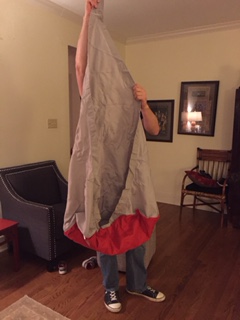
In Ikea last June, I saw this swing – the Flurge – a cocoon-like swing which could be hung from the ceiling, taking up a relatively small space in a corner to offer a child a little private, swinging hideaway.  I bought it immediately, thinking about Henry, my 8-year-old who has struggled with sensory processing issues.  We’ve had Henry in tons of OT since he was 4 and, at the start of each weekly session, his occupational therapist would put him in a special, enclosed swing to help him “organize his vestibular system”.  He focuses more, knows where his body is in space, and even better performs motor planning (like telling his hand how much pressure to give the pen to effectively write), after certain organizing exercises like swinging.   His OT, a brilliant and compassionate young woman who looked like she was in the 7th grade, would end each session by giving me a list of homework to do with Henry.  Wheelbarrow to build shoulder strength, “cross-crawl” exercises to better connect his right and left brain hemispheres, sand paper letters he could trace with his fingers.   But the pace of work-kids-dinner-laundry usually meant that I’d be shouting something from the kitchen on the night before his OT appointments like, “Henry, get out your sand paper letters!” or “Hey kids, have a wheel barrow race, whydontcha?”  I felt tipped forward under a tremendous yoke of guilt that I was not finding enough time or energy to give him these extra, critical doses at home.

So when I saw the Flurge, it ignited in me so much of how I feel about this constant quest to find new resources for Henry. Under the clean, bright minimalistic lights of Ikea, it fused the tactical with the strategic in a sleek Nordic nonchalance. A tool that would help Henry in a deep and powerful way, and propel him to full mind-body integration as well as redeem me as a mother.  Much in the same way as Athleta makes me feel that a biking skort would engender amazing core strength AND a sense of meaningful intellectual contribution in the world AS WELL AS flirty athletic day-dates with my husband. We all get that.  That’s the hook-end of longing.  But it’s not the source.  It’s not why I bought the Flurge.

Try.  Try to know.

If I had spent half a minute with a reality check, I’d have seen what Steven saw and said immediately when I brought it home:  “How am I going to hang that? I don’t think we have studs in the playroom ceiling and it’ll pull the dry wall down.”  In the heat of the moment (read: 6-8 months) I obviously interpreted this as a personal failing on Steven’s part.  Where was his can-do spirit?  His resourcefulness? His basic carpentry skills?

I bought the Flurge because I am afraid that I can’t give Henry enough on my own.  That if I can find a smart, energetic OT and the perfectly Swedish-engineered umlaut of a device, I can crack the code to help him thrive in the amazing, quirky, brilliant way his soul is arcing towards.

But if I am trying, really trying, there’s more. If I stay in this feeling and try to get to know it, then in that difficult meetup, I recognize the less-than-flattering reality that the Flurge was always more about me than Henry. I’m wanting a hyper-designed balsam-wooded device to prove I am an amazing mother.  That I am doing it Right. That I am getting an A.  That Henry’s sensory and motor challenges are something I own, and can control, and can thereby treat as a task to tackle, conquer and cross off the list.  Rather than the reality —  that it’s an integral part of him and his own journey, wholly separate from me and not without its own gifts, which I can attend and aide, but never fundamentally own.  As hard as the realization can be, I also find it an enormous relief to know we only walk next to each other, touching shoulders, but never really carrying the other – even our own children.

All this was a slow dawning. For nearly a year, the Flurge sat in its package on top of the dryer, an emblem of failure, wrapped in cellophane resentfulness.  I would bang shut the dryer door, wondering how Steven could live with himself.

IMG_8270
The Flurge that almost destroyed my marriage

I recently read a so-so article with the amazing title, “America’s Obsession with Adult Coloring Books is a Cry for Help.” Remembering that title when I saw the Mother’s Day display at World Market – two dozen different adult coloring books from mandalas to botanicals, Asian-motifed bathrobes, and winewinewine – made me want to both laugh and cry in a wild, hysterical bark.  A national cry for help, in sandalwood and lavender and pino grigio! Do you love your mother? Then facilitate that grown-ass woman the ability day drink in a bathrobe and color hummingbirds with children’s craft supplies in a quiet, and likely angry, desperation.

The article talked about coloring books being just on the whispered cusp of productive mindfulness, without quite being self help, therapy or exercise for burned out, overworked, overstressed people looking, frantically, for something a little healthy to take the edge off.  But what the article didn’t touch at all was a cry for help for WHAT?  The article did not try to know.

We don’t need a protective psychological barrier to advertising and marketing so much as we just need to be willing to Try.  We don’t necessarily need more boundaries, we need more awareness, and a strength that doubles as self-forgiveness.

Try to be willing to make a map that starts on page 47 of Athleta (or your own magazine of choice) and run your fingers along it until you come to the source, and then pause there, gently, tenderly, they way you might when you discover a hidden nest, or a note a child has written, or maybe even your younger self.

Stay there until you know its bulk and heft, its shape and its texture — stay there until it becomes familiar and you become kind. Acceptance is trying too.


On Preservation

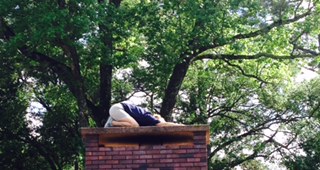
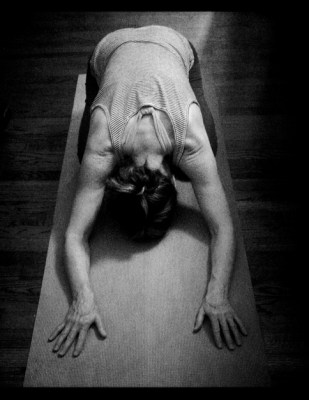
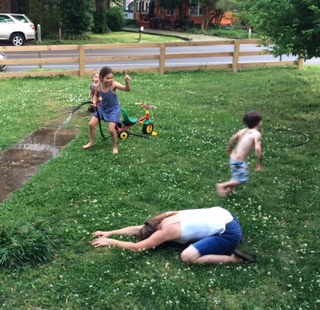
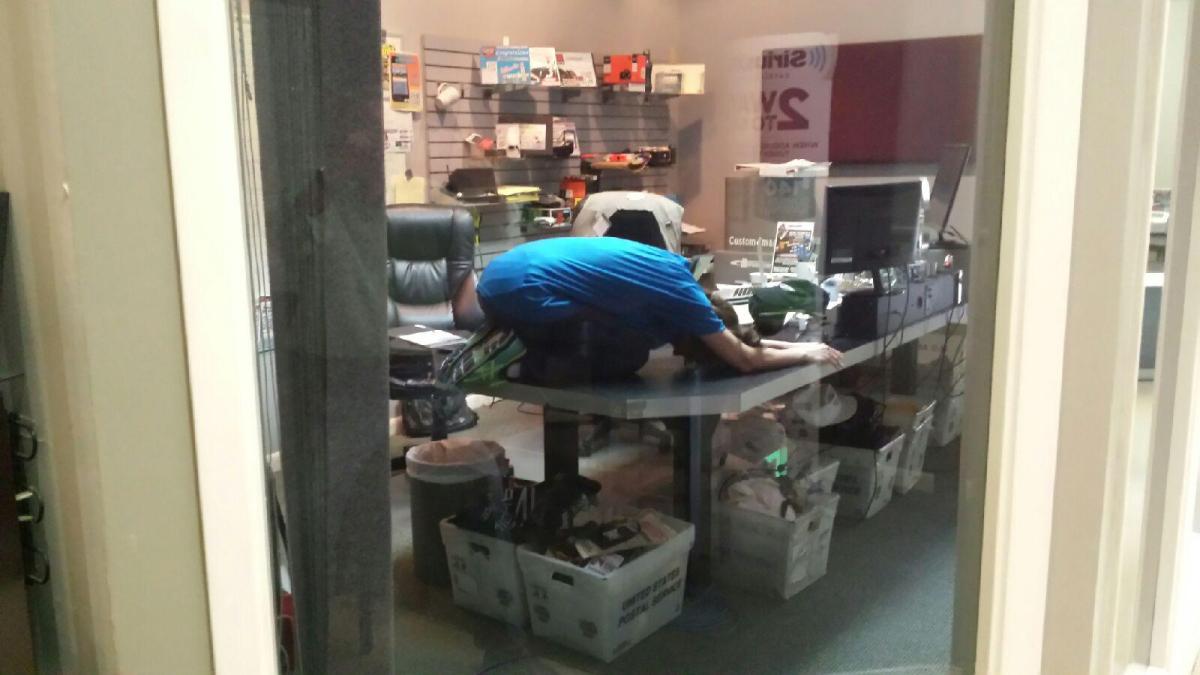
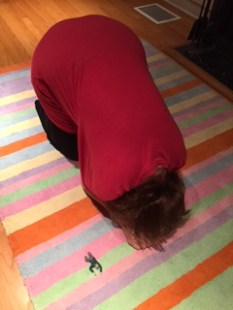
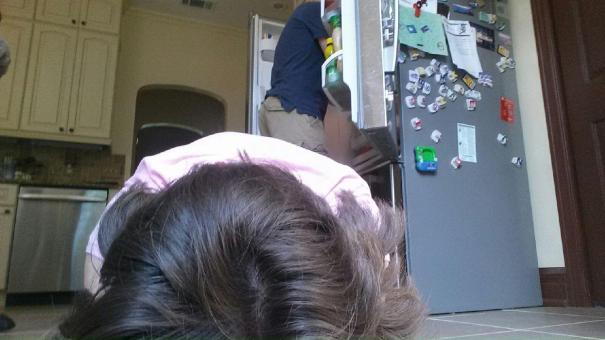
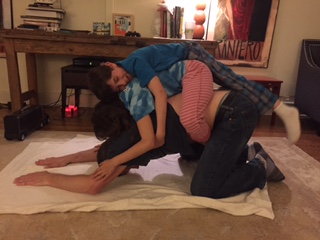
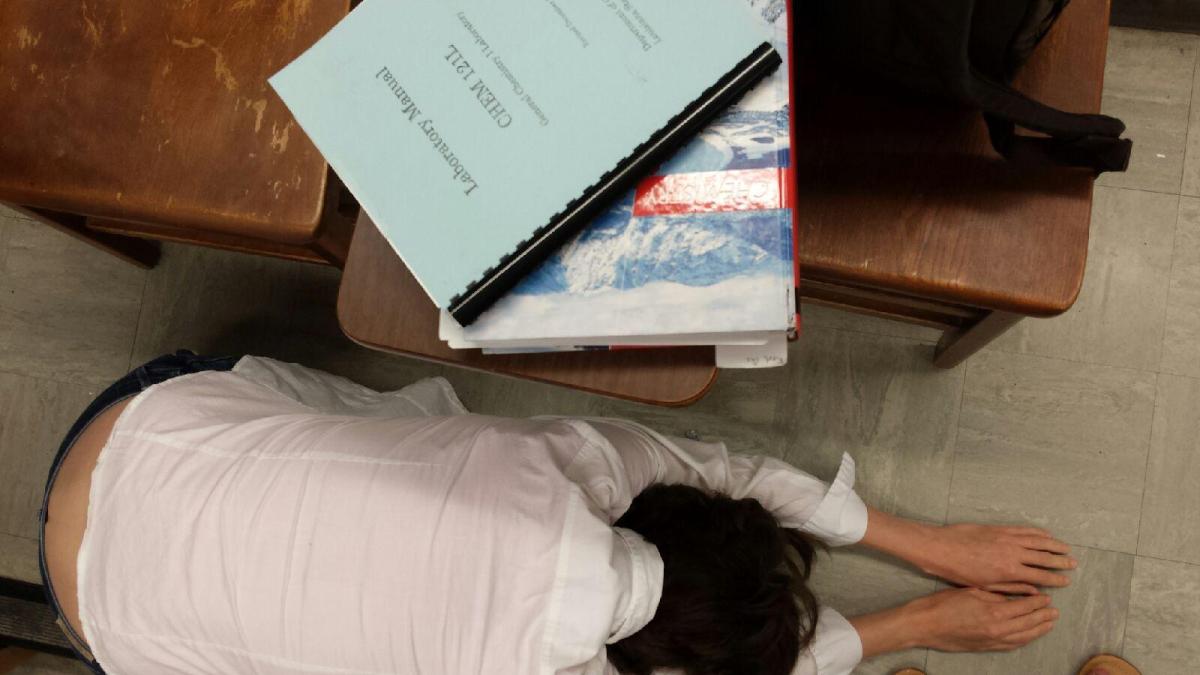
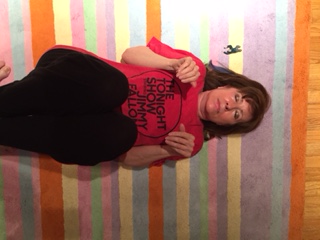
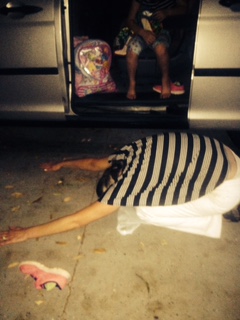
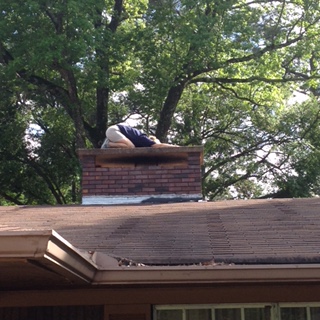
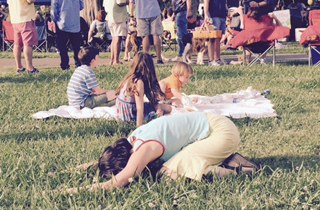
You guys, I recognize that it might appear that I am focused on a theme of face plants right now.

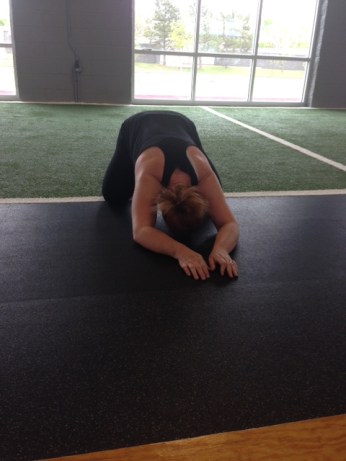
But this is totally different.  TOTALLY DIFFERENT! This is the Wisdom of child’s pose.  This is the child’s pose of Power. Of Self Actualization. Can you not see the Wisdom and Power and Self-Actualization?

It’s subtle.  Look closer.

FullSizeRender[1]

Closer still.

FullSizeRender[2]

When I see a yoga student drop to child’s pose in the middle of one of my classes, I always think, “That’s one smart yogini right there.”

It’s interesting that to an untrained eye it might look like a face plant borne of despair or defeat – but actually, it’s the ultimate go-to-ground power play to restore oneself, one’s most essential self.  Too often I wait until things get to a near-shattering point before taking child’s pose, my breath ragged, some deep unnamed interior muscle near strained.  But the more I practice, the better I am getting at politely showing my ego the door and assuming child’s pose instead of down dog (or whatever the seemingly ambitious choice in life is) when I know I need rest more than productivity.

Right now I am feeling elated by this work in writing, excavating, analyzing and getting “out there.”  But to tell you the God’s honest, I’m feeling pretty exhausted too.  So I am taking a child’s pose of Power with this short entry this week.   And it feels salient, not only because it’s what I need to regain a little quiet in my head and heart, but also because preservation is necessarily the fraternal twin of usefulness.  There is no effective usefulness without self preservation. And without self kindness, without sometimes quite literally folding in half and pressing my face to my knees to make the world go soft and dark – I spin out of control.

I once took a wheel pottery class with these lovely, experienced older potters.  Delighted with a new student, they were all too happy to show me how to work the wheel, applying steady pressure on the foot pedal to keep it spinning, while moistening the clay as it began to reveal itself.  In my enthusiasm (and impatience) my foot got heavier, the wheel spun faster and the clay began to rock in an undulating asymmetrical orbit, its arc widening wildly and gaining a sickening momentum.  I remember the room getting very quiet for a beat or two before the once-affable faces of those ladies turned to disapproval, then horror, as the clay finally flung itself around the room over all of us in a thousand small wet, cloying pieces.  It never occurred to me to let my foot up off that pedal.

We fling ourselves out to the world and it is good and healing and expanding.   And we reel ourselves back within our interior selves, and it is just as good, just as healing, just as expansive.

The trick is knowing, of course, when to do what. And really, there’s no trick at all. It’s simply flexing most fundamental and often most flaccid muscle we’ve got — listening.

If you are feeling in a similar space, a call to quiet and go within, a moment needed to fold in half and shore up a little energy, I challenge you to send me a picture of you in your own child’s pose of Power, Wisdom and Self Actualization!  On your kitchen floor, on aisle 34b of Target, near your office desk — wherever you might be called to double down on your energies, aggressively building up the supply for your next great leap.  Send it on and I will upload next week in what will hopefully be a collage of raw, unbridled primal strength, genius self-insight, and Oprah-like emotional intelligence.

(one tip – I suggest a quick check for red bugs or ants or other bities if you plan to go nose down in Child’s at your neighborhood park’s spring fling festival).

On Usefulness

I am so genuinely confused by women who’ve had multiple children AND who are able to show their midriffs. I mean, really, my biggest emotion around this — bigger even than jealousy (although that is there for sure) — is just total incomprehension. It seems to bend the laws of physics. Was there a vitamin I missed? Are they a separate species?

But that is not the essay I’m going to write today.

I’ve been thinking a lot lately about the fueling power of feeling useful.

Being of actual and real use to someone is a far greater gift than any kitchen utensil, any all-expense-paid vacation, maybe even any post-multiple pregnancy abs. Positive usefulness in another person’s life will make you taller and kinder, your smile wider, your hair bouncier, your heart more open. Feeling useful to someone else might even save you. It has for me, although it seems to be one of those lessons I have to remember to remember every 30 minutes, with a start of happy surprise each time.

There was an entire period of time in late 2014 that — when I conjure it up in my head — the only image that comes to mind is of me facedown on the playroom carpet. No doubt because metaphysically, psychically, emotionally, I was. I had been struggling to feel of value with my work and my family, to feel a sense of real meaning, that I was contributing in a way that was resonating and valued. The part time-ness of both working and parenting meant that of course I felt I was doing neither well, constantly interrupted and too hamstrung at work to reach my full potential, and too distracted and busy to effectively manage the whack-a-moles at home, losing my cool with the kids and going all Babadook far too often. I felt demoralized by own effort – simultaneously exhausted and disappointed in myself on all fronts.

I am incredibly gifted at being able to go from the sense that I am failing at something to the certainty that ALL IS LOST and the only answer is to quickly move to another town and change my name and erase my life, so that Steven will have time to remarry and the kids get used to another mother before too much damage is done and the truly formative years begin. This is about a 90-second journey. Usually, I am lucky enough to either get a friendly phone call, or gin up the strength to pick up what Anne Lamott calls the “1,000 pound phone,” and the effect is almost immediate. WAITASECOND – I don’t need to stage my own death, I just needed to talk to a friend! Huzzah! That’s about a 60 second journey. But the total 2.5-minute process from bottom to top and the taste of that carpet fiber – oh man.

In November of 2014, from my face plant in the carpet, I heard the phone ring. Amazingly, it was a friend I had not spoken to in the near-20 years since college. She told me she was ready to tell her story about sexual assault in college, prompted and emboldened by the recently released Rolling Stone expose (that would later be discredited due to some very poor journalism) on a “culture of rape” at our alma mater, emblematic of the problem on campuses nationwide. “Would you help me tell this,” she asked, “maybe even just a letter to the Board of Visitors?”

I slowly picked myself up off the playroom floor, lint stuck to my cheek – I was reminded of my former self, this younger me who fought in public forums for social justice and women’s equality. And now, I was needed in the present. I was needed!

J and I worked together for months, drafting and redrafting, talking to first amendment lawyers and trying to better understand libel laws and free speech. We were able to eventually place her brave and clear-eyed piece in the Opinion section of the New York Times, (above the fold, I might add) on Sunday, April 4, 2015. This friend is perhaps the most courageous person I know, and she alone dealt with all the emotion, visibility, risk and healing of the piece – a piece which touched hundreds who commented and contacted her (and doubtless thousands more who did not). Recently she told me that she now has a new anniversary, one that supersedes and trumps the assault anniversary, and marks when she told her story publicly, helping to give voice to the thousands assaulted on campuses every year, and offering constructive criticism on a broken judicial system. She is, to me, the very picture of what heroism looks like — as well as what it looks like to heal yourself through helping others.

On the sidelines at her elbow, I felt such intense gratitude. To have been struggling with a feeling of worthlessness in my tiny world, and then be called upon to help a friend find her words and her loudspeaker felt transformational. It surprises every time she thanks me, then and now. And each time I try to tell her that the gift was all mine, the thanks is all mine to give her. She gave me a greater purpose and true usefulness, in the only way it matters. She thought she was asking for help by reaching out to me, but in effect, by needing me she was throwing out a lifeline.

Moving back and forth between the opposite sides of needing and usefulness is like the passing of the peace from hand to hand, and it happens daily in ways both tiny and beautiful.

My best friend and I have intentionally created a sacred space for each other, where we always take the other’s call, and find time to walk through the other’s need, no matter how small, how big, how tangled, how tedious. You can’t do this for many, of course. One or two at the max. But it is a relief to know she is consistently there as a safe couch I can fling myself upon and say, “So, I got this email I don’t how to interpret” or talk through the exact wording of a challenging situation. It works – both because we love each other and because I do the same for her.

Sometimes when she calls me from her office to ask me which flight she should take from DC to Bonn, Germany, I’ll have a pot boiling over on the stove, the older kids fussing about homework and the toddler finding something to turn into a missile. I will strain my brain to follow the pro’s and con’s of different routes and layovers, and my first instinct is to quickly say “Heathrow! Take the Heathrow option!” But my immediate next thought is always – how lucky am I that this friend values and wants and even needs my opinion. Her need transforms me from a frazzled mom who’s trying to time the mac and cheese production with homework completion to someone thinking through which international connections best fit my friend’s priorities and needs. For a little while, I am broader than the kitchen chaos. Not that the kitchen chaos is a negative, but sometimes we all need to be taken out of whatever 10×12 room we are occupying.

Sartre was full of shit. Hell is not other people, hell is isolating yourself while among others. Hell is living in community but not reaching out. When I was a teenager, I would sometimes wake up before the whole house and get in my car and drive around until it was time for school, sometimes for an hour or more. More than once I saw my uncle driving on the same deserted streets, though I don’t think he ever saw me. A gentle and troubled man who later took his own life, he was always a mystery to me and glimpsing him on those pre-dawn drives was as intimate a view of him as I ever got. The memory is crystal clear even now, Donnie smoking a cigarette with his window rolled down, tanned in his white undershirt, driving easy and aimless with one hand, headed towards the interstate while the sky behind him pinked and turned orange. I can’t know what he was thinking on those drives, but in my 16-year-old mind, it felt like we were out there together, cruising empty streets and sharing in a certain loneliness and a restless search for connection. I don’t know if that’s true, but I do know that my uncle’s lack of asking for help, of saying aloud what he needed, ultimately proved lethal.

Bringing awareness to the fueling power of usefulness has a ripple effect. It’s so easy to think our meaning lies in our intelligence or industry or achievement. But it’s when we reach out with vulnerability that we open ourselves to the experiences that bring purpose and meaning to our lives.   This is the very thing I must remember to remember when I am reluctant to ask for help, to call up and say, “Can you do this for me?” Or even “Do you have a minute to listen?” It always feels like such a big deal to ask, doesn’t it? But what if I could view it as a truly caring, altruistic thing to do for someone else?

It’s worth trying. Because we cannot know how much each other needs to be needed. And because maybe you are out there, right now, in your own personal face plant, eating the turf du jour, battling your own internal demons and hoping and praying the phone might ring and your bat signal gets thrown into the night sky.

The Liquid Family

I’m not sure it’s possible to glimpse a full picture of how families work until you’ve lived a little time. Until you’ve lost people, or let other ones go, until you’ve built a few families out of several lean years of eating beans and rice and helping each other move, or raising children and helping each other move, or walking through marriages and deaths and helping each other move. You don’t really know just how fluid families can be until parts of your own dissolve, and then somehow it rains again, and family comes together — half familiar, half new — in a whole new way.

I spent a long while under the illusion that families, like histories, were factual — fixed immobile objects that created the topography of our lives. Everything else, then, gets mapped and populated around these fixtures – here a raging, white-capping river; there a gentle green valley; up north that Matterhorn of a snowy peak, jagged and critical. We think of our worlds as concrete and unchanging: my childhood WAS this, this person IS that, that particular relationship – ugh – don’t get me started. …Except of course that any Geology undergrad worth her North Face fleece would tell us that all landforms mutate constantly.

In my twenties and thirties, I saw how I could reshape my geography with chosen family, architecting what I believe are some pretty amazing shapes on my personal globe. I am not certain of too much, but I do know that if I have one talent, it is tricking, conning or otherwise dragging the kindest, funniest and smartest friends into my orbit. It’s an incredible gift to have amassed this collection. And not just for the glitter of them all – but because my friends are the people that make me an immeasurably better person.

I could write a tome about my friends – about the one who sent me a clip of Al Green singing, “Hold On…I’m Coming,” by way of letting me know she was boarding a plane, at a moment’s notice, to come to me when I was in acute crisis. Or another who calls me nearly every Friday, no matter how much work she has or what little person is vomiting in her house, and says, “tell me how you really are.” Or another still who kept me from drowning during the biggest tsunami I’ve faced and says our souls would recognize each other anywhere. Or my husband who sometimes cares more about my happiness than I do myself. If I didn’t have this double-fisted handful of incredible friends to laugh with, to sort things out with out, then I don’t know who I’d be. Or whether I’d still BE at all.

But the families we are born into can hold just as much kaleidoscope discovery. My family of origin, which I had thought of as both fixed and nearly lost, is just as kinetic, as it turns out. My brother and I are back in each other’s lives, in a way more present and clear, after a long fog of unknowing and worry. And I continue to learn, in different ways, from both of my parents posthumously. I am forever unpacking gifts my mother tucked into the 14 years we had together as I come upon new challenges in parenting, or work on getting better at self-care (the latter learning by her antithesis). I have grown greater compassion for my dad, moving to something beyond forgiveness, more akin to the tenderness you might feel as a parent for your small child who is hurting. (Aging without your parents means that even those roles become fluid and shift too). As hard and even baffling as moving back to my hometown was after so many years away, living among these ghosts has broadened my perspective of my past, helped me to drop old stories and create new patterns. And there is relief in newness.

When I first moved back to town, two months after my dad died, I went to his headstone and ringed it with pinecones I found, less to commemorate him and more to say IWASHEREIWASHEREIWASHERE. I was here all along, I was your daughter, I was desperate for your love without condition, I was desperate for your acceptance, I was desperate for you to see me, really see me, standing right here.   We are always in conversation with our parents, aren’t we? Later I dreamed of him. In the dream, he had a separate house we discovered after his death, the rooms full to bursting with my and my brother’s childhood books, favorite stuffed animals, art projects and drawings. …As our relationship has changed even after his death, I can see that really was a separate room in his heart where he kept those things, after all.

Even our view of the mighty Matterhorn changes, its rocks and inclines sliding and softening, slow and viscous.

But the most surprising is the family formed without any engineering at all – neither through the luck of biology nor the butterfly net capture of friends and partners. Throughout this time, my stepmother was tunneling through her own intense grief and emerged out of the darkest part right in the middle of my life. It was like she bore her way through her own pain and came up, pick axe in hand and miner’s hat shining, right up through the floor in the middle of my living room. It was a welcome place, and surprising, as that wasn’t our proximity when my dad was alive.

We had spent parts of the past few decades not really understanding the other, my stepmom and me. We are different enough in personality, and often found ourselves in a defensive posture on what felt like opposing teams. But then children were born – which always changes things – and then time and other people’s deaths changed it more. What is so beautiful now is that our differences are not only negligible, but even endearing and something we can tease each other about. And now that we are fully able to put my parents’ old resentments and pain to bed, we can truly see each other. We don’t take this miracle for granted. It’s deliberate and full of tenderness, like slipping out of fatigues and a flak jacket to get into a bubble bath.

It’s a particular brand of family to be first thrown together by circumstance, then to choose love, to choose each other. It’s characterized by a yielding, a release of all the old stories and a willingness to laugh at how, for all our illusions of control, it’s life that changes us. And not the other way around.

All credit for the unexpected gift of my current relationship with my stepmother goes to her gigantic heart and generous spirit. While my learning to yield into an ebbing landscape has been hesitant and cautious, hers has been a driving force. While I grieved the sense of being orphaned, she lassooed me in, good and tight. While I hung on to the old landmarks and their shadows, ponderously analyzing the tea leaves of it all, she simply walked up and rang the doorbell.

I look at family now, chosen and biological, with a bit of wonder. It’s possible to lose the people who felt like the firmament, and watch so much fall away – and then, to witness family coming together again, not only in the way we think of change – as unexpected and new — but also, incredibly, from the old landforms as well.

I mean really, it’s ALL chosen family. There’s no distinction. We are not fixed and static, and so the family is fluid, breeching its levees, altering its course, changing us. The friend family, the biological family, the ones we marry, the ones with whom unlikely circumstance throws us together. It’s all chosen family, even the toughies… the people that make you crazy, the ones who never really see you like your best friends do, the ones who do come around to seeing you, although you never thought they would — even them, your spirit has chosen.

And in this mixed bag of family, I like to think we would all recognize each other’s souls anywhere.

The Life Changing Magic of Not Giving a F*ck: A book review


Marie Kondo’s The Life Changing Magic of Tidying Up took so many of us — and our closets and spice racks and junk drawers — by storm last summer. A tidy, beautiful and controlled storm, like the whorled patterns created by rows of T-shirts, rolled and standing on end, alert little manicured cadets ready for deployment. She taught us to move category by category throughout our homes and our lives, gently holding each object and asking ourselves with all sincerity whether the item in question “sparked joy.”

It rocked my world, as I know it did many others. I started with a huge pile of reusable grocery bags, dumped on the floor of my kitchen, and realized that of the 14 (fourteen!), there was no way I would actually use more than five. I moved to blankets, linens, towels, then kitchen cabinets, then closets (what self respecting grown person needs 23 pairs of tube socks, Steven Abney?), then the playroom, where I even got the kids in on the action. Henry: “Charlotte, you have three cat stuffed animals. The white one has never sparked joy for you.” Finally, I took a huge glass of wine into my office closet and bravely and painstakingly went through photos and letters and documents, some of which I had hauled around in milkcrates from my college apartments through the 7 homes in 5 states over 20 years since, without having ever unpacked them. Talk about an albatross. The joy thing was incredibly liberating. What joy was there in keeping my Economics notebooks? To prove I had an education? Au revoir, 3 boxes of indecipherable graphs and doodles. Or what about my grandmother’s pictures of a trip to Hawaii, wherein no actual people were featured and it wasn’t my memories anyway? Adios, 200 slides –- slides! –- of volcanos and golf courses. Or an even greater weight loss: the huge file of my parents’ divorce papers. What possible joy could I take in keeping that? Sayonara to 2 bulging files of 35-year-old receipts and other people’s pain.

All in all, I hauled out 44 bags of trash or recycling (the tall kitchen bags, mind you), and took what amounted to $3000 worth of donations to Goodwill and area shelters. The attic and creepy, dank storage space under the house still remain, and – weirdly – the tube socks must be playing some Barry White and multiplying late at night – but I nonetheless ended 2015 feeling very virtuous indeed.

So what could possibly rival that kind of total house colonic? Friends, I am so glad you asked. For the past month, I’ve been thoroughly enjoying Sarah Knight’s Practical Parody, entitled: The Life-Changing Magic of Not Giving a F*ck. Heavy on the practical, Knight introduces her book as one “for all of us who work too much, play too little, and never have enough time to devote to the people and things that truly make us happy.” The book is a hilarious and highly useful guide to mental decluttering, just as satisfying (if not more so) than taking out all those bags of trash and donations. And for those of us who are what Knight calls “born f*ck-givers” – overachieving perfectionists and pleasers who have spent a lifetime giving f*cks liberally to every project, task, standardized test, authority figure, friend, notion of obligation, ideal or patriotism … then, well – the book is a special treat.

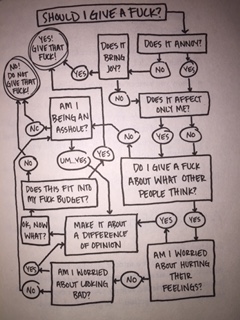
Waitasec – is this just about shooting the bird at anything or anyone that doesn’t make you feel good? No way. Knight offers a careful guide to help you give fewer, but better quality f*cks, and to do so in such as way as to ensure you are not being an asshole. Carefully gauging whether someone else’s feelings would be truly hurt naturally informs whether you give a f*ck, and how much of a f*ck you might give. Bringing intentionality to your f*ck-giving, and being able to distinguish between feelings and opinions, are the twin keys to being happier without being a total dick. Applying her careful methodology in sorting through the messy squirrel’s nest of my own head and heart then became a clarifying process. And for the visually-oriented reader, she provides several helpful flowcharts and schematics.

IMG_8114
Knight, Sarah. On giving, and not giving, a f*ck. Page 39.

The process of tidying up my sock drawer of f*cks, if you will, has already helped tremendously in several small situations just in the past few weeks. For example, when Henry’s pet bearded dragon died last month, he immediately began begging me for a ball python, (which he had wanted from the start, but I managed to talk him into a lizard).

Now, I give a Great Big F*ck about not having a snake in the house, of course. But Henry gives an even greater f*ck about desperately wanting a pet snake, and as a twin who shares his sister’s pink and purple room, he has very little to call his own. When I examined my own f*ck, I saw it was preference-based and not actually rooted in real danger (ball pythons have no fangs, no venom, and there’s been no recorded incident of them killing a human). The math then became: Henry’s f*ck > My f*ck

We got a snake.  And importantly, I didn’t spend a ton of energy fighting or worrying the decision.

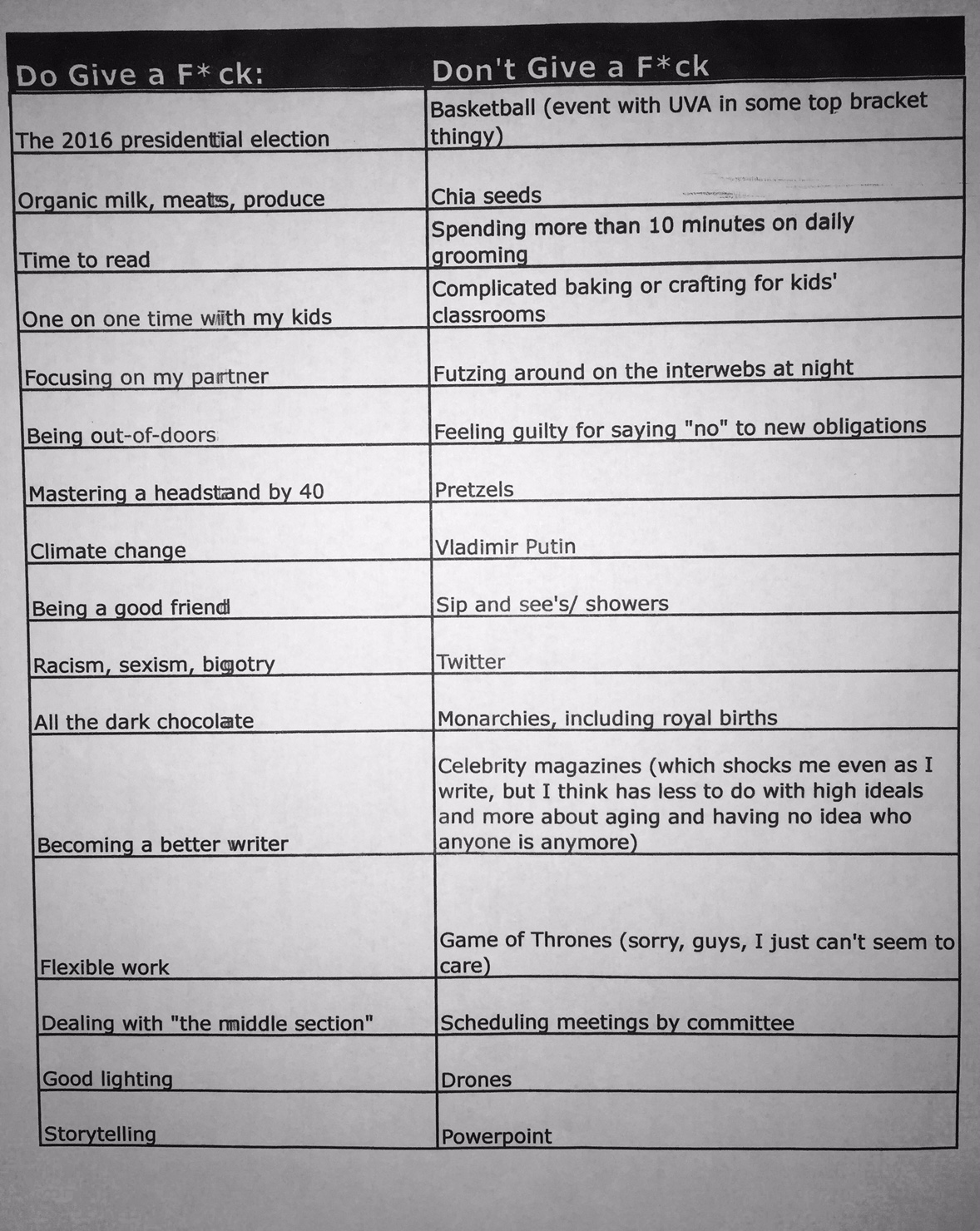
It’s not just about what f*cks you don’t give, but identifying where you do give a f*ck – and then finding the time, energy and money to allocate them accordingly. I have recently learned I love writing this blog and now happily make the time to give a f*ck to do it, even if there are dishes still in the sink at 10pm and several emails and phone calls to return. So how can do you do this on a grand scale? You create a F*ck Budget, answers Knight. Rather than explaining how it’s done, I’ll just share mine. It’s a work in progress, and of course, the f*cks expressed are mine alone. Yours would certainly look different.

FullSizeRender

The process of creating a f*ck budget is almost more useful that the product itself because it clarifies and helps prioritize what is aspirational (feeling guilty for saying “no” to new obligations), highlights where I’ve got my allocations all wrong (dicking around on my computer at night INSTEAD of spending time with Steven) and usefully validates what I already know to be true about myself. (I hate pretzels. HATE them. And I am tired of trying “just this one special German kind” because you absolutely love it and it’s from this ah-mazing local bakery). There is power in declaring. Just writing it down for myself in these categories frees me up from ever having to “try” another bite of that nasty salty dough, and sets me on a path to get serious about that headstand.

My f*ck budget also yields a more refined sense of precisely how precious few f*cks I have to give, so that I can give them in a highly mindful and purposeful way. For example, if I have a heightened awareness that I do give a f*ck about good, quality chocolate, then I have more of a fighting chance at not sticking my head in the pantry and stress-eating the kids’ crappy leftover Easter candy when there’s a pre-dinner mutiny. I’ll save that f*ck and give it over to a really nice dark chocolate with sea salt and toffee I got during my last Trader Joe’s run in a calm, ladylike and dignified way after 9pm. Ideally.

I don’t know, you guys. There’s a lot of gimmicks out there. I’d love to Kondo the hell out of the self-help section of Barnes and Noble. But some new ideas and methods have substance and can make a dent in the entropy of our unraveled edges and loose coins. And here’s the thing: when Sarah Knight says that the 3 types of people who don’t give a f*ck are children, assholes and the enlightened – I know which one I want to be.

Wisteria


My peoples and I are headed out of town this Sunday for a little communion with mighty Ozark mountains, so I will miss a Monday post this week, and will instead leave you with this little ode to my favorite spring bloom and her unrepressed Big Love.


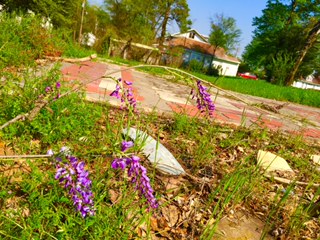
Wisteria, you indiscriminate springtime slattern,

throwing yourself at the most wanton vacant parking lots

bottlesdiaperscigarettes strewn among the weeds

concrete busted in places

Or against the sagging telephone wires, threaded through dead trees

A tangle of barren brown branches no one cares about enough to prune.


Here is where you stretch yourself out, long and luxurious?

Here is where you bloom, all those fecund floral grapes dangling?

Like Bacchus himself had partied a little too hard

On the wrong side of town

Is for the shock effect, like a rebellious teen, this display of poor taste?

Have a little pride! we want to shout.

Or maybe –

You and your jiggling purple petals not quite that vapid.

Flinging all that plummy glory around,

decorating the forgotten armpits of our city

as if to say, I stand with Pema Chodron:

Compassion is not our service to those on the margins,

but our willingness to see ourselves in kinship with them.


Wisteria, magdalen blossom who reminds us of our better selves,

the indiscriminate self that doesn’t first size up,

the self that shares our best jokes with whoever comes along,

the self that looks for beauty everywhere, in every dandelion-filled driveway

because we’ve learned the hard way that

it all matters.

All of it.